Building on a legacy: 37 years of the Faculty of Science and Technology
Foreword:
Over the past 45 years, the University of Macau (UM) has continuously adapted its academic structure to reflect the evolving needs of society and the advancement of knowledge. To address increasingly complex technological and societal challenges, UM will restructure the Faculty of Science and Technology (FST) and the Faculty of Health Sciences. Starting from 1 August 2026, the two faculties will be reorganised into four new entities: the Faculty of Information Science and Computing, the Faculty of Engineering, the Faculty of Science, and the Faculty of Medicine. In addition, UM will establish a new Faculty of Design. This initiative is not simply an organisational restructuring, but a comprehensive and forward-looking institutional reform. A new academic framework—built around the integration of medicine, engineering, information science, and intelligent technologies—is beginning to take shape. In this article, we look back on FST’s journey—from its founding to its transformation and renewal. By revisiting faculty milestones, we reflect on the path it has taken and consider the direction it will pursue in the years ahead.
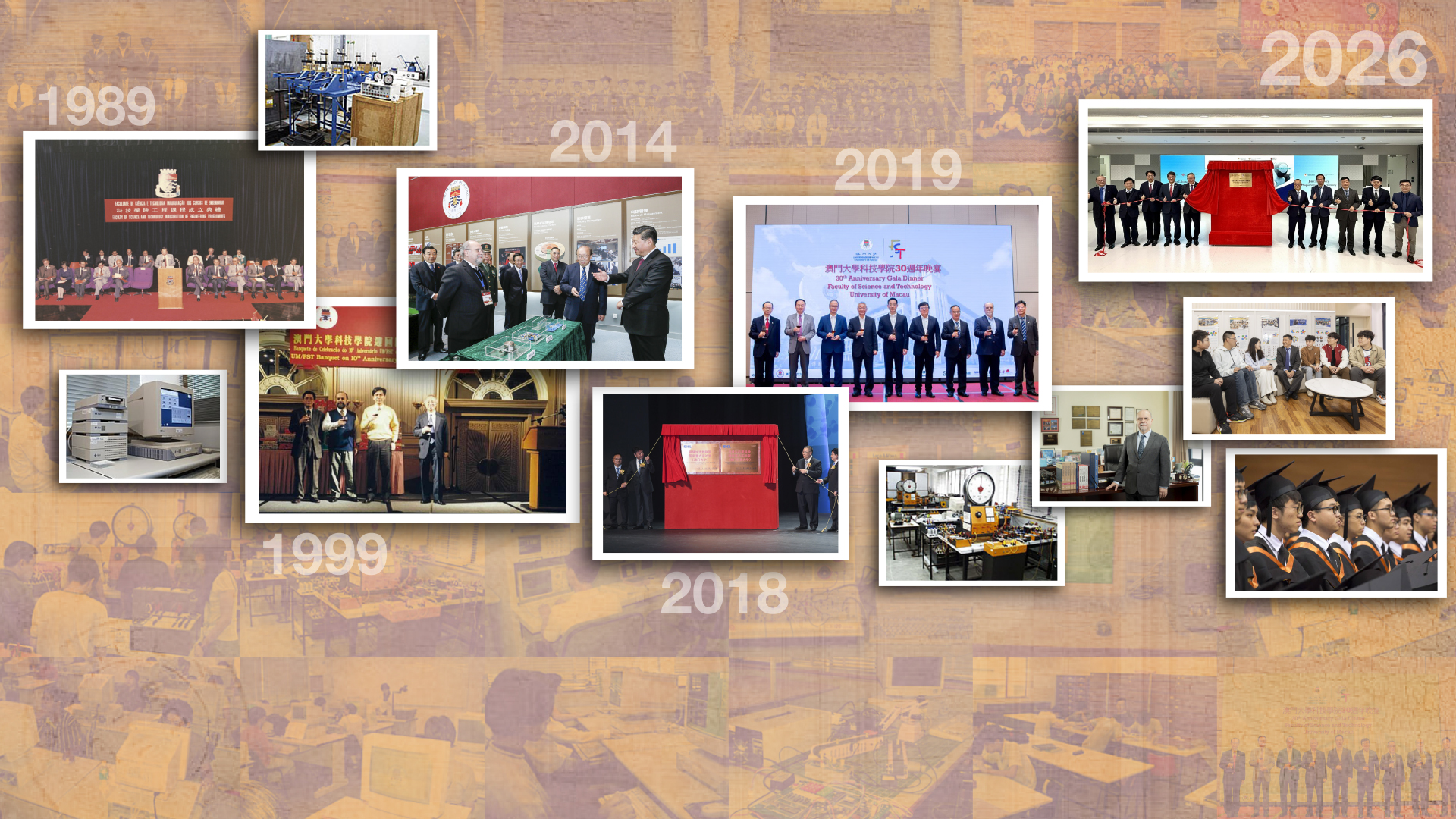
From 1989 to 2026, FST has undergone 37 years of steady growth and transformation. What began as a small laboratory with rudimentary experimental facilities has evolved into a high-level research platform aligned with national strategies. Over time, FST has transformed in fundamental ways. Once focused primarily on undergraduate teaching, it has developed into a research-intensive faculty with a growing doctoral community and a significant increase in high-quality research output. This evolution has been driven by the dedication of its faculty members and the strategic vision of university leadership. The transformation of the faculty has involved not only advances in research, but also reforms in talent development, evaluation systems, and industry collaboration. Together, these efforts have reshaped FST’s academic profile and laid a strong foundation for its next stage of development.
From humble beginnings
In 1989, UM established FST with two founding programmes: Civil Engineering and Electrical and Electronics Engineering. A year later, the programmes in Software Engineering and Mechanical Engineering were introduced, marking an important step forward for science and technology education in Macao. The early years, however, were far from easy. Prof Rui Martins, who joined FST in 1992 after moving to Macao from Portugal, recalls that teaching and research infrastructure were limited and the curriculum was still evolving. Most faculty members at the time were visiting scholars from the Chinese mainland, along with several Portuguese academics. There were very few locally trained professors. The Civil Engineering programme, the earliest FST programme, began with just two full-time faculty members and around a dozen students. It was not until 1991, when the first cohort progressed into specialised areas of study, that FST’s faculty team began to expand more steadily.

Inauguration ceremony of FST’s engineering programme, 1989
Faced with these constraints, FST focused on strengthening its academic foundations. The faculty standardised its curriculum, refined its degree programmes, and ensured compliance with government accreditation requirements, providing students with a clear and reliable pathway to graduation. Simultaneously, the faculty adopted a dual strategy: cultivating local talent while recruiting scholars from overseas. A structured academic career ladder—from teaching assistant to lecturer, associate professor, and professor—was gradually introduced. In 1993, FST launched its first postgraduate programme, selecting outstanding local graduates for advanced study. This marked a significant step toward building a sustainable local academic community and supporting the faculty’s long-term development.

The first graduating class of the Electrical and Electronics Engineering programme, 1993
Research soon became a defining feature of FST’s growth. In its early years, the faculty identified three priority areas: microelectronics, machine translation, and environmental engineering. Among them, microelectronics proved particularly significant. In 1994, Prof Martins led a group of ten master’s students in electrical and electronics engineering to develop Macao’s first locally designed integrated circuit—the ‘UMChip’—which was manufactured by AMS in Austria and tested at UM. This milestone laid the foundation for the university’s later achievements in integrated circuits research. Between 1993 and 1996, FST published 108 papers in international journals and conference proceedings across fields including civil engineering, electrical and electronics engineering, mechatronics, software systems, and mathematics. Although these research efforts were still at an early stage, these achievements established a solid foundation for the faculty’s continued advancement.
Building momentum
In 1999, FST celebrated its tenth anniversary and entered a new stage of steady consolidation and growth. The faculty strengthened the organisation of its disciplines and continued refining the curriculum structure. A notable milestone came in 2002 with the establishment of the Department of Mathematics, which broadened and deepened the faculty’s academic foundation. At the same time, FST focused on developing its faculty team. In 2000 and 2002, respectively, the first two local PhD graduates in Microelectronics obtained dual degrees from Instituto Superior Técnico in Lisbon, Portugal. Both later returned to join FST as assistant professors. By 2002, FST had developed a strong faculty body comprising more than 20 professors and associate professors, along with approximately 50 assistant professors, lecturers, researchers, and assistant researchers.
FST 10th anniversary gala dinner, 1999
Research activity also accelerated during this period. In 2000 alone, FST published 116 papers in international journals and conference proceedings. Among its growing research areas, integrated circuits emerged as a defining strength. The early integrated circuit laboratory—the Analog and Mixed-Signal VLSI Research Laboratory—was modest in scale. Initially housed in a garage on the old campus, it later moved to two small rooms in the car park of the Pearl Jubilee Building. Funding was limited, equipment was basic, and space was tight—conditions that made sustained research challenging. A turning point came in 2005 with the establishment of the Macao Science and Technology Development Fund. With access to dedicated research support, the laboratory began to expand and enhance its research capacity. Building on this momentum, UM applied in 2009 to the Ministry of Science and Technology to establish the State Key Laboratory of Analog and Mixed-Signal VLSI (SKL‑AMSV), which was approved in 2010. Inaugurated in 2011, SKL-AMSV became the first state key laboratory in microelectronics in the Guangdong-Hong Kong-Macao Greater Bay Area, marking a significant elevation in the faculty’s research profile and national standing.
During this period, FST also gained broader international recognition. In 2012, the faculty’s bachelor’s programmes in civil engineering, electrical and computer engineering, and electromechanical engineering passed the academic review of the Hong Kong Institution of Engineers. In 2014, these programmes were formally recognised under the Washington Accord. This recognition enables graduates to pursue professional engineering qualifications in other member countries and regions, underscoring the international credibility of UM’s academic standards. The faculty’s progress was also reflected in global rankings. Between 2016 and 2018, in the Times Higher Education World University Rankings, UM’s engineering and technology disciplines were placed within the 100-125 band worldwide, while computer science ranked within the 175-200 band.

In 2014, three FST Bachelor of Science programmes were recognised under the Washington Accord—the first such accreditation granted to a higher education institution in Macao
UM’s relocation to the campus on Hengqin Island in 2014 created further opportunities for growth. With improved facilities and expanded space, FST experienced steady increases in faculty size, student enrolment, and research activity. The Institute of Applied Physics and Materials Engineering was established in 2014, followed by the State Key Laboratory of Internet of Things for Smart City (SKL-IOTSC) in 2018. By 2019, the 30th anniversary of its founding, FST had educated approximately 80% of Macao’s electromechanical engineers, 50% of its electronic engineers, and 25% of its registered civil engineers. It had firmly established itself as the leading centre for science and technology education in Macao.

Inauguration of the State Key Laboratory of Internet of Things for Smart City, 2018—the first state key laboratory dedicated to smart city IoT
Transformation and renewal
In 2019, FST reached a defining moment in its development. Although the faculty had established a solid foundation, it was confronting structural challenges. Undergraduate students accounted for more than 55% of total enrolment, while the number of doctoral students remained relatively limited. High-impact research output needed to be strengthened, interdisciplinary collaboration had yet to fully mature, and a strong culture of innovation was still taking shape. That same year, Prof Xu Cheng-Zhong—an internationally recognised expert in parallel and distributed computing—joined FST as dean. He articulated a clear vision: to ‘place quality at the core of the faculty’s development and use innovation as its engine for growth’. Under Prof Xu’s leadership, FST launched coordinated reforms in talent recruitment, research platforms, and institutional mechanisms, accelerating a transition from a predominantly teaching-focused faculty to a research-driven one.

On 20 December 2014, President Xi Jinping visited UM and learned about the university’s research developments from Prof Rui Martins
Central to this renewal was the expansion and upgrading of research platforms. Building on the foundations of SKL‑AMSV and SKL‑IOTSC, and aligned with the university’s broader strategic plan, FST developed collaborative innovation platforms across electrical and electronics engineering, computer science, artificial intelligence, civil engineering, and environmental science. Since 2018, the faculty has also established five interdisciplinary research centres: the Centre for Artificial Intelligence and Robotics, the Centre for Regional Oceans, the Centre for Data Science, the Centre for Cognitive and Brain Sciences, and the Centre for Applied Mathematics. Together, these initiatives have strengthened cross-disciplinary collaboration, broadened research horizons, and enhanced the faculty’s ability to attract leading international scholars.
Talent recruitment has been another cornerstone of this renewal. In recent years, FST has recruited more than 70 professors with academic backgrounds from leading institutions such as the Massachusetts Institute of Technology, Stanford University, the University of Cambridge, and the University of California, Berkeley. This has fostered an increasingly international and research-intensive academic community. At the same time, the faculty reformed its Faculty Academic Performance Assessment (FAPA) system. Evaluation criteria were revised to place greater emphasis on originality and real-world impact. New initiatives, including a ‘First Paper Breakthrough’ award, were introduced to encourage publication in top-tier journals and conferences. In 2025, the faculty further expanded its recognition framework to support interdisciplinary scholars who excel in both fundamental research and technology transfer, reinforcing closer ties between research and industry.
These reforms have delivered measurable results. The proportion of FST publications appearing in Journal Citation Reports (JCR) Q1 journals—the top 25% by impact factor—has risen from below 50% to over 75%. Several disciplines are now ranked among the world’s top 100, and engineering and computer science are placed within the top 0.1% globally according to Essential Science Indicators (ESI). The number of FST scholars recognised among the world’s top 2% scientists has increased from 14 to 72, and six faculty members have been elected as academicians in their respective fields. In the 2024 Macao Science and Technology Awards, FST faculty accounted for 45% of all award recipients.
A series of landmark achievements reflects this renewed momentum. Chair Professor Gui Changfeng of the Department of Mathematics achieved a major breakthrough on the long-standing ‘hot spots conjecture’ for triangles, marking the first time a Macao scholar has published in Inventiones Mathematicae, one of the world’s leading journals in mathematics. Assistant Professor Zhong Junwen of the Department of Electromechanical Engineering developed a highly agile electronic insect, with the research published in Science Robotics, a leading journal in the field. Assistant Professor Xu Huanle of the Department of Computer and Information Science developed a cloud-native architecture optimisation solution that has helped companies such as Alibaba and Huawei significantly reduce computing resource consumption. Together, these accomplishments demonstrate not only FST’s accelerated progress, but also its growing contribution to Macao’s economic diversification and to technological innovation across the Guangdong-Hong Kong-Macao Greater Bay Area.
A new chapter: The transition to three faculties
After 37 years of development and achievement, FST is entering a historic new chapter. The faculty will be reorganised into three distinct entities: the Faculty of Information Science and Computing, the Faculty of Engineering, and the Faculty of Science. Prof Martins and Prof Xu both strongly support this transformation, though they interpret its significance from different perspectives. For Prof Martins, the reorganisation enables each discipline to sharpen its focus and build on its core strengths. In his view, the Faculty of Science should concentrate on foundational disciplines—mathematics, physics, and chemistry—thereby reinforcing excellence in basic research. The Faculty of Engineering should continue advancing technology transfer and deepening engagement with industry. Meanwhile, the Faculty of Information Science and Computing is well positioned to serve as a forward-looking hub connecting artificial intelligence, microelectronics, big data, and emerging engineering fields.

Prof Rui Martins
Prof Xu regards the restructuring as a crucial step toward the faculty’s next phase of development. With nearly 180 faculty members, more than 1,100 doctoral students, and 15 first-level disciplines, the existing organisational structure can no longer fully support sustained and in-depth disciplinary growth. As the transition progresses, strategic planning and practical implementation are being carried out in tandem to ensure stability and continuity. ‘We are guided by the principles of careful planning, a smooth transition, and an unwavering commitment to quality,’ Prof Xu explains. ‘We are optimising the disciplinary structure, introducing a system in which faculty members hold a primary appointment in one department while maintaining joint appointments in others, and supporting cross-faculty flagship programmes that balance disciplinary depth with interdisciplinary collaboration.’

Prof Xu Cheng-Zhong (centre) believes that the restructuring is pivotal to FST’s next stage of development
While the structure is evolving, both professors emphasise that FST’s core values remain unchanged. The spirit of seeking truth, acting with pragmatism, and pursuing innovation continues to underpin the faculty’s long-term development. As Prof Martins notes, ‘No matter how the structure changes, FST’s commitment to rigorous scholarship and service to society will remain constant.’ The three new faculties will carry forward the legacy built over nearly four decades. By integrating more deeply into the national innovation system, strengthening collaboration among academia, industry, and research institutions, accelerating the translation of research into practical application, and continuing to cultivate interdisciplinary scientific and technological talent for Macao and the Greater Bay Area, the new faculties will open a new chapter in UM’s contribution to technological advancement and national development.

Over the years, FST has cultivated numerous science and technology professionals for Macao and the Guangdong-Hong Kong-Macao Greater Bay Area
Video
Chinese Text: Gigi Fan, UM Reporter Yang Wenyan
English Translation: Bess Che
Photo: Editorial Board, Jack Ho, with some provided by interviewees
Video: Hasen Cai, David Tong, Sam Chan
Source: My UM Issue 153