Lyu Hanyue’s pursuit of legal scholarship
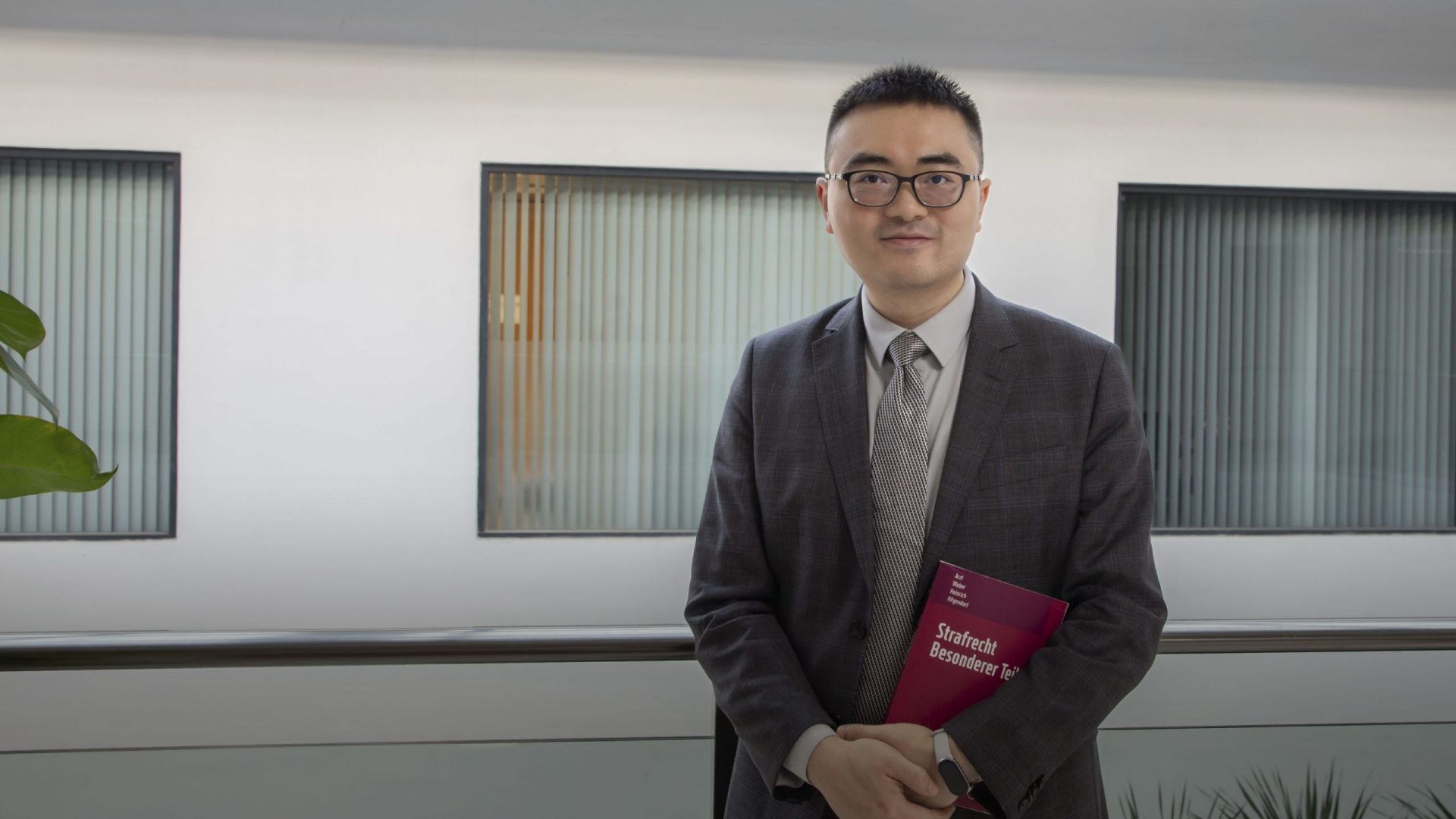
From a rural primary school classroom to the forefront of global legal scholarship, Lyu Hanyue’s journey has been shaped by unwavering perseverance and years of dedicated self-study. He earned admission to the renowned law schools of Peking University and Tsinghua University, later continuing his studies in Germany, where he developed a distinctive legal perspective that blends Eastern and Western traditions. Today, he is an assistant professor in the Faculty of Law (FLL) at the University of Macau (UM) and a researcher at the Asia-Pacific Academy of Economics and Management (APAEM). His work delves deeply into criminal dogmatics while also exploring emerging areas such as artificial intelligence (AI) and the digital economy. Committed to fostering meaningful international dialogue in criminal law, Prof Lyu draws on global insights and China’s legal practice to continually explore, enrich, and innovate contemporary legal theory.
From late-night study to passing the judicial examination
Stepping into Prof Lyu’s office, one is immediately drawn to the floor-to-ceiling bookshelves that chart the evolution of his academic life. The titles trace a clear intellectual journey: the Civil Code of the People’s Republic of China sits beside German criminal law commentaries, while the General Principles of Criminal Law is shelved next to Kant’s Critique of Pure Reason. Together, these dense legal treatises and classic works of philosophy reveal a scholar intent on building bridges between legal doctrine and philosophical inquiry.
What might surprise many is that this scholar, now deeply engaged in criminal law theory and pioneering interdisciplinary research at the intersection of technology and law, began his academic career in mathematics. At the School of Mathematics and Statistics at Wuhan University, Lyu lived in a world defined by formulas and theorems—a realm of pure logic. Over time, however, he felt drawn towards a discipline more closely connected to the complexities of human life. That was when law captured his attention: a field equally rooted in rigorous reasoning, yet inseparable from real‑world values and societal questions.
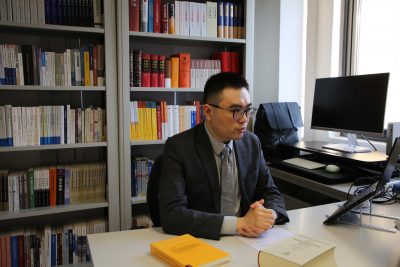
Behind Prof Lyu stands a bookshelf richly lined with legal volumes
Lyu’s journey into law began late at night, illuminated only by the faint glow of a single lamp in a quiet countryside home. After completing his bachelor’s degree, he moved to Dasha Town in Kaiping, Guangdong, to work as a primary school teacher. By day, he taught math and Chinese at the chalkboard; by night, he studied law alone within that small circle of light. With limited resources, Lyu assembled his own curriculum from whatever textbooks he could buy and scattered materials he found online.
‘My goal was simple,’ Lyu recalls. ‘I just wanted to see if I could truly master the subject on my own—and maybe even pass the National Judicial Exam.’ In 2011, after only one year of disciplined, solitary study, he passed the notoriously difficult exam with a score of more than 400 out of 600. More than a credential, the achievement became a turning point. ‘It made me believe,’ he says, ‘that I could really build a future in this field.’
Thirty thousand words of distilled insight
Passing the exam was only the beginning. To build a real academic career, Lyu knew he needed systematic training. He applied to the Master of Laws programme at Peking University, making his ambitions clear from the outset. At the time, postgraduate law degrees in the Chinese mainland were divided between the practice-oriented Juris Master and the research-focused Master of Laws. Lyu chose the latter without hesitation, telling his prospective supervisor clearly that he wanted to pursue an academic career.
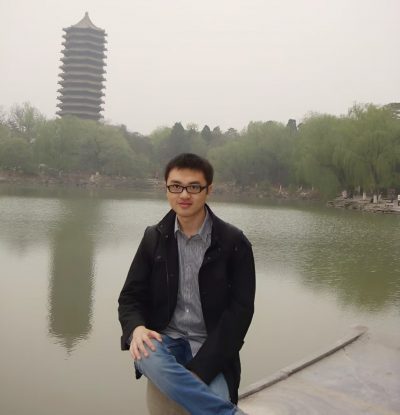
Prof Lyu Hanyue by the Weiming Lake at Peking University
During the interview, his clear, well-reasoned answers left a strong impression. The examiners may have wondered how a self-taught candidate had managed, in such a short time, to reach a level on par with students who had received formal legal training. The explanation lay in a simple yet demanding method of study: Lyu took authoritative textbooks—together totalling over a million words—and condensed them into a coherent set of personal notes. Inspired by the ‘mastering one classic’ approach advocated by Yi Zhongtian, a well‑known alumnus of Wuhan University, Lyu selected one definitive textbook for each major area of law. He read each book meticulously, analysed its logical structure, and distilled its core ideas. For criminal law, for example, he chose Prof Zhang Mingkai’s 1.2-million-word Criminal Law Tutorial and transformed it into a 300,000-word digest.
‘Honestly, my motivation at the beginning was purely practical—I just wanted to pass the exam,’ Prof Lyu says. But his line-by-line, deeply analytical approach ended up giving him a foundation far beyond what the test required. After he started his studies at Peking University, he chose to specialise in criminal law after careful consideration, especially as he revisited the works of scholars such as Zhang Mingkai and Chen Xingliang. ‘I wanted a field with a relatively complete legislative system and a rigorous, internally consistent logic,’ he explains. ‘In fact, the structure of criminal law is quite similar to mathematical thinking—it relies heavily on formal logic. Analysing a case means moving from the major premise, to the minor premise, and finally to the conclusion.’
Publishing original research in German
While Peking University gave Prof Lyu a strong foundation in criminal law theory, it was his doctoral studies at Tsinghua that allowed him to shift from absorbing knowledge to examining its origins.
Lyu discovered that Tsinghua’s emphasis on raising new questions and upholding logical rigour aligned closely with his own mathematical sense of proof. He was no longer satisfied with interpreting individual legal issues; instead, he began focusing on the broader theories that underpin the doctrinal system. Under his supervisor’s guidance, Lyu’s research gradually moved from technical interpretation to deeper questions of legal principle. During this period, he also began studying German in a systematic way. For Lyu, the language was not just a tool—it was the key to accessing original texts in the civil law tradition. It allowed him to move beyond the limits of Chinese secondary literature and engage directly with the forefront of European legal theory.
Gradually, a goal began to take shape: to contribute the voice of a Chinese scholar to the German academic world. In 2016, through a Tsinghua exchange programme, Lyu studied at the University of Tübingen in Germany, where he later remained to pursue a second doctorate in law. He believed that only by completing a full doctoral programme in Germany could he truly enter the local academic community, develop advanced scholarly writing skills in German, and ultimately publish original research in the language. To Lyu, this was the path towards enabling genuine two-way dialogue between Chinese and German legal scholarship and establishing his presence in the German-speaking academic sphere.
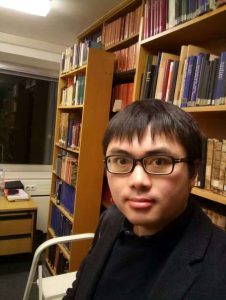
Prof Lyu Hanyue during his academic visit to Germany in 2016
During his time in Germany, Lyu specialised in the theory of joint criminal enterprise, conducting a systematic comparative study of the legal systems of the Chinese mainland and Macao. This work gave him an interdisciplinary perspective that drew together different legal traditions, historical developments, and comparative analysis. The rigorous logic and structured methodology of German legal training further sharpened his ability to dissect complex legal issues with clarity and precision. By immersing himself in local scholarship and writing papers in German, he significantly strengthened his academic communication skills—building a strong bilingual foundation for future international research in both English and German.
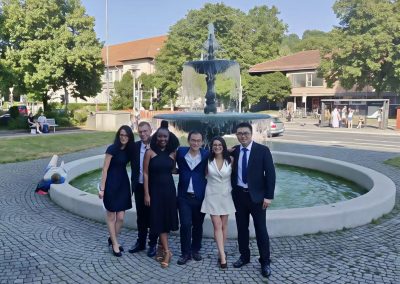
Prof Lyu with fellow students at the University of Tübingen in Germany
Innovation at the crossroads of East and West
In 2023, Prof Lyu joined the UM FLL, seeing Macao as the ideal place to put his academic vision into practice. ‘Macao is a unique bridge,’ he says. ‘It preserves a strong civil law tradition while maintaining a genuinely international outlook—making it the perfect environment for innovative legal research.’
At UM, Prof Lyu’s work focuses on two main areas: systematically introducing the German tradition of legal commentary to strengthen the analytical framework and practical relevance of local legal scholarship; and advancing interdisciplinary collaboration by integrating insights from the brain sciences and social sciences into foundational legal discussions, such as debates surrounding the age of criminal responsibility.
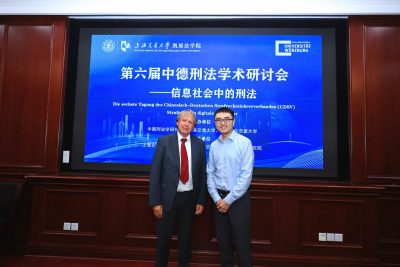
Prof Lyu and his German supervisor, Prof Bernd Heinrich (left) at the Sino-German Criminal Law Academic Seminar at Shanghai Jiao Tong University
During his second doctoral programme in Germany, Prof Lyu was deeply influenced by the German style of legal commentary. In Germany, commentaries are treated as authoritative references, organised article by article and incorporating case law, theoretical analysis, and practical interpretation. This structure, he explains, significantly improves efficiency in both judicial practice and academic research. In contrast, Macao’s existing criminal law commentaries largely follow the Portuguese tradition, which he believes leaves room for improvement in practical usability and systematic organisation.
Prof Lyu emphasises that a legal commentary is more than a technical reference; it is foundational scholarship that clarifies a law’s internal logic and the sources that shape it. Such work supports judicial practice while also offering comparative perspective that address broader international issues. He notes that the commentary tradition also has deep roots in Chinese legal history. The Tang Dynasty’s The Tang Code (唐律疏議), for example, is an early example of this approach. Following the enactment of China’s Civil Code, many scholars have adopted German methodologies in their own commentary projects. Now, Prof Lyu plans to develop a German-style commentary in Macao, beginning with a systematic interpretation of key legislation such as the Law of the People’s Republic of China on Safeguarding National Security. His goal is to clarify ambiguities and promote greater consistency in legal application.
Prof Lyu is also dedicated to promoting interdisciplinary integration between law and other academic fields. Working with units such as the Faculty of Social Sciences and the Centre for Cognitive and Brain Sciences, he advocates for incorporating empirical scientific findings into legal debates. On issues such as the appropriate age of criminal responsibility, he argues that legislative reform should be guided by evidence from brain sciences and psychology, rather than driven solely by public sentiment. This reflects his broader commitment to grounding legal research in scientific rigour and methodological precision.
Legal education in the age of AI
As AI continues to reshape the practice of law, Prof Lyu has already begun to see its impact in the classroom. ‘You can see traces of AI in students’ assignments,’ he notes. Instead of resisting this trend, he is looking for ways to help students use AI thoughtfully and critically, turning it into a tool that enhances rather than replaces legal reasoning. ‘AI can help with processing information, organising literature, and compiling sources, but at the heart of legal education is still the cultivation of thinking—how to ask meaningful questions, build rigorous arguments, and exercise independent judgment.’ This, in his view, is the essence of legal thought—something AI cannot replace.
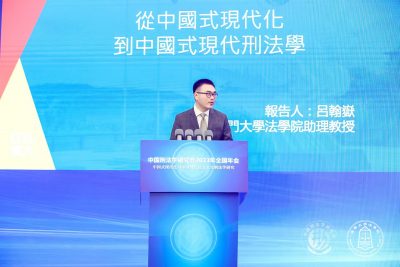
Prof Lyu delivers a speech at the annual conference of the China Criminal Law Society in Beijing
As a researcher at APAEM, Prof Lyu’s work remains rooted in the criminal dogmatics while also addressing emerging challenges posed by AI and the digital economy. He notes that many of the legal issues arising from new technologies—such as the legal nature of cryptocurrencies, electronic payment fraud, and data ownership—are not entirely new. Rather, they bring to the surface deeper theoretical tensions within traditional legal frameworks. For example, the classic civil law distinction between ‘real rights’ and ‘obligatory rights’ proves insufficient when applied to digital assets.
‘This means that simply relying on existing legal provisions is no longer enough to address the challenges we face today,’ Prof Lyu explains. ‘To keep up, we need to revisit foundational legal theories and, when necessary, look beyond traditional disciplinary boundaries to develop new concepts and systemic adaptations.’ His research seeks to integrate perspectives from criminal law, economics, and technology governance, exploring how fair and efficient legal rules can be rebuilt for the digital age.
Pursuing knowledge through an arduous journey
From the pure logic of mathematics to the complex realities of law, and from a rural schoolteacher to a scholar connecting Chinese and German legal traditions, Prof Lyu’s path has been shaped by a commitment to systematic rigour, a practical understanding of real-world issues, and a dedication to fostering dialogue across legal cultures. His journey reflects a core belief: meaningful innovation in law comes not from staying within established boundaries, but from thoughtfully integrating different ways of thinking across them.
Prof Lyu’s work continues to develop in Macao, a city where East and West meet. Alongside teaching criminal law at UM, he is helping the faculty build more systematic curricula and teaching materials, and exploring foundational yet important topics through specialised modules. For Prof Lyu, the idea of pursuing knowledge through an arduous journey is more than a personal sentiment. It is a long-term mission: to deepen scholarly understanding and promote meaningful exchange across legal traditions through careful, bridge-building research.
Chinese Text: U Wai Ip, Trainee UM Reporter Tian Minyu
Chinese Editor: Gigi Fan
English Translation: Gloria Kuok & Bess Che
Photo: U Wai Ip, with some provided by the interviewee
Source: My UM Issue 149