Li Jinlong: An eight-year journey from student to mentor
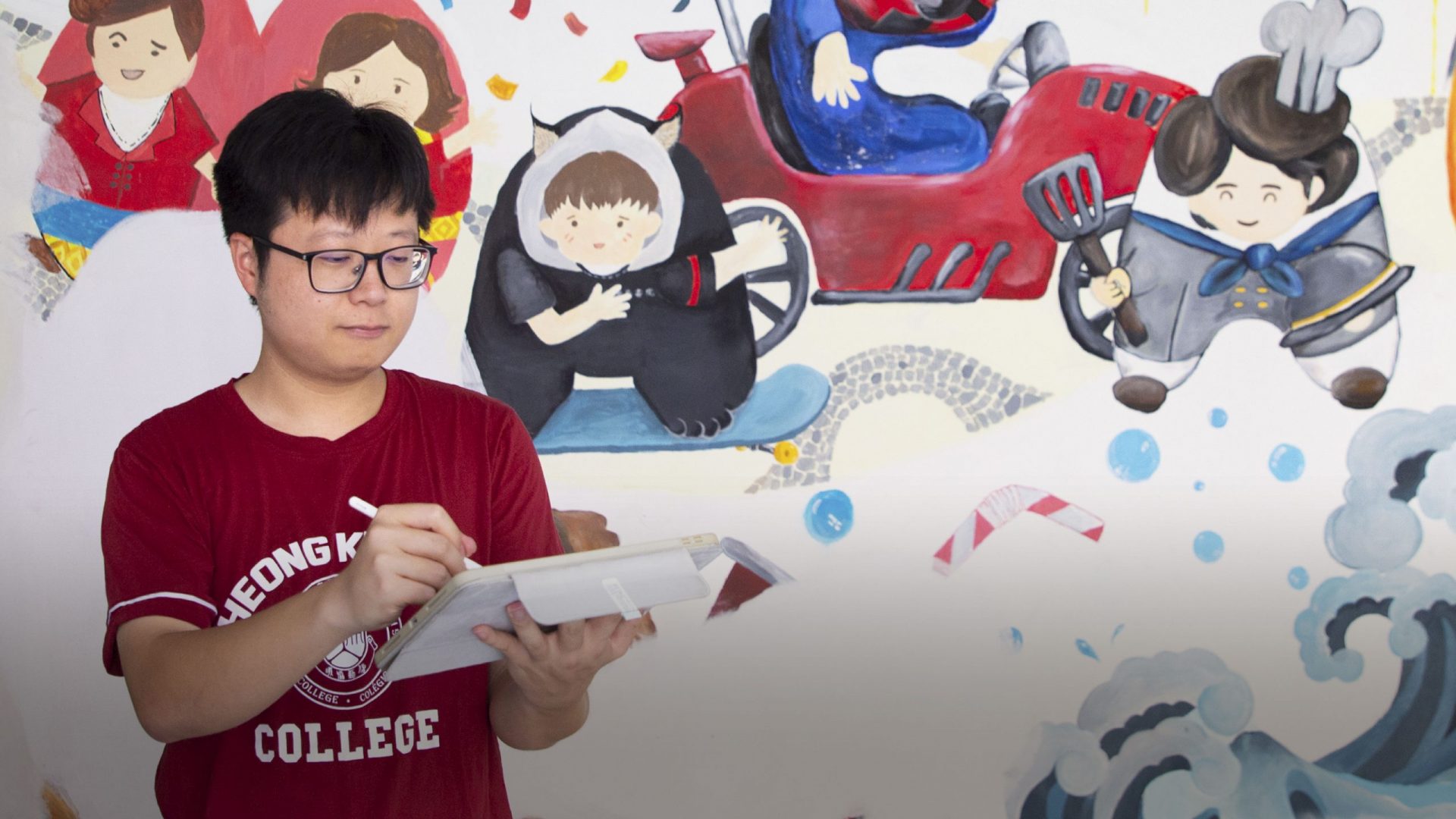
Across eight years at the University of Macau (UM)—from his undergraduate and master’s studies to his current doctoral work—Li Jinlong has developed into a versatile and forward‑thinking young scholar. He serves as a resident tutor (RT) guiding students in smart technologies, an entrepreneur creating AI‑driven learning tools, and a researcher working at the intersection of engineering and neuroscience. Rooted in computer science and drawing on fields such as the Internet of Things (IoT), brain–computer interfaces (BCI), and intelligent education, Li has built an academic journey marked by both intellectual depth and a broad interdisciplinary vision.
Guiding students in unmanned technology
At Cheong Kun Lun College (CKLC), an ‘unmanned technology team’ brings together undergraduate engineering students from the Faculty of Science and Technology. United by a shared interest in smart technology, the team is led by Li, their RT and a second‑year doctoral student in electrical and computer engineering.
Li is a strong example of UM’s interdisciplinary talent development. From his undergraduate studies in computer science to his master’s specialisation in IoT and now his doctoral research in BCI and brain disease analysis, Li has steadily broadened his expertise. During the second year of his master’s programme, he applied to become an RT at CKLC. ‘Residential colleges are full of possibilities,’ he says. ‘They’re not just places to live—they’re platforms that help students push their limits.’
The unmanned technology team grew out of that spirit. The idea came from CKLC College Master Wong Man Chung, an engineering expert who is particularly interested in the social impact of unmanned technologies. Hoping to encourage collaboration across different years and majors, he proposed creating a platform where engineering students could learn from each other and build practical skills. That idea became the team.
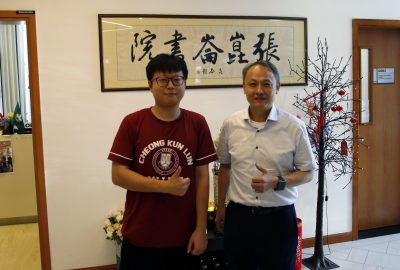
Li Jinlong and Prof Wong Man Chung
As an RT, Li not only manages daily affairs at the college but also uses his technical background to guide and mentor students. He enjoys exploring real‑world AI applications with them, offering support and encouraging them to apply what they learn to solve practical problems. Naturally, he stepped into the role of mentor for the unmanned technology team. Under his guidance, students track industry trends, read research papers each week, and work on AI tools designed to improve everyday life on campus.
The team has already achieved notable results. Members created a WeChat chatbot called ‘CKLC Smart Kunkun’, an AI assistant that answers common questions and provides support during orientation, reducing the workload for college staff. The source code is open to all CKLC students, encouraging them to contribute ideas and improvements. Li is also leading the team to refine the chatbot’s beta version by expanding its database and improving its features to make it more helpful and intuitive.
Another project in progress is the ‘Smart Electricity Meter’ system, developed to address students’ laundry needs. Li teaches students about hardware integration, software development, and network communication, helping them gain hands‑on experience with device interconnection, data acquisition, and cloud‑based monitoring. The goal is to eventually let students check washing‑machine availability in real time on their phones—making campus life more convenient.
Looking back on his mentoring experience, Li describes it as a two‑way learning process. Students’ creativity often inspires him, and teaching helps him fill gaps in his own knowledge. For him, the AI tools developed by the team also embody UM’s student‑centred approach to education.
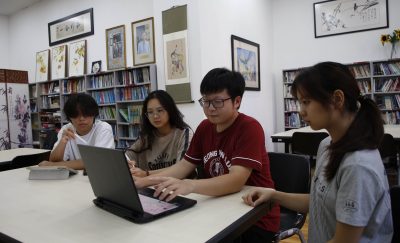
Li Jinlong in a discussion session with college students
Entrepreneurship in AI-powered education
After completing his undergraduate degree, Li did not head straight into the workforce. Instead, he chose to continue his studies by enrolling in UM’s newly launched master’s programme in the Internet of Things—a decision he now sees as a turning point. By then, he had already built a solid foundation in programming, cybersecurity, web development, decentralised algorithms, and deep learning. His master’s studies expanded his opportunities even further, giving him the chance to participate in projects at the State Key Laboratory of Internet of Things for Smart City. ‘It happened right as ChatGPT was kicking off a new technological era,’ he recalls. ‘My research interests aligned perfectly with that moment.’
Encouraged by his residential college, Li took part in UM’s innovation and entrepreneurship competitions, where he met a senior student also majoring in computer science. Together, they formed a team and launched an intelligent education platform called ‘RapiLearn AI’, combining their technical strengths with real market needs.
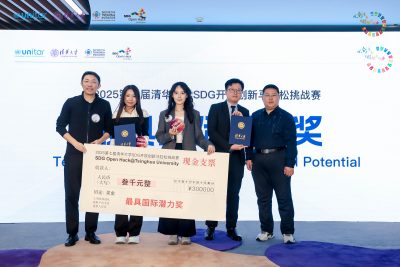
Li Jinlong and his team win an award at a Tsinghua innovation and entrepreneurship competition
RapiLearn AI is a personalised learning system that blends deep learning with human–computer interaction. Available around the clock, it can analyse a student’s learning progress, create customised study plans, and automatically generate exercises and materials—offering a learning experience tailored to each user. The system is currently open to college students and has already helped improve study efficiency.
‘AI is changing the way we learn’, Li says, noting how transformative these tools have become. ‘In the past, studying often felt like doing everything on your own—you had to process knowledge independently, and without taking the initiative, it was easy to miss useful resources. But now, through interaction with AI, knowledge is more accessible, and learning materials can adjust dynamically to each person’s progress. That’s what real personalised education looks like.’
Li and his team continue to improve RapiLearn AI and are working to introduce it to more online communities. They hope to give more people access to innovative AI‑powered learning tools and help usher in a new era of personalised education.
Advancing the frontiers of BCI technology
Li’s experiences at CKLC and his entrepreneurial projects helped shape his interdisciplinary strengths, but his doctoral research takes him into even deeper scientific territory. Questions he pondered as a child—about consciousness, identity, and the possibility of some form of human eternity—resurfaced as he began exploring the complexities of the brain. ‘If consciousness could exist independently of the physical body, could humanity achieve a different form of eternity?’ he once asked himself. These early curiosities eventually steered him towards brain science.
The technical foundation Li built during his undergraduate and master’s studies proved invaluable as he transitioned into BCI research. His academic leap was guided by his doctoral supervisor, Prof Wan Feng, a veteran researcher in BCI with extensive expertise in cognitive and brain sciences.
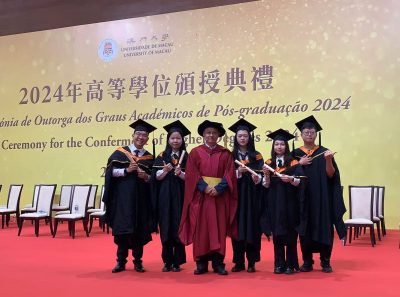
Li Jinlong with his professor and fellow students at the UM graduation ceremony
Li notes that his background in computer science gave him a strong grasp of programming, algorithms, and system design, while his master’s work in IoT deepened his understanding of sensor networks, edge computing, and hardware integration. ‘The essence of IoT is connecting the physical and digital worlds—and BCI is a powerful expression of that idea in the life sciences,’ he explains. ‘From signal acquisition and embedded systems to neural data analysis, every stage demands knowledge from multiple disciplines. I’m fortunate that everything I learned earlier is now coming alive in my research.’
In Prof Wan’s laboratory, Li is weaving together his past training and transforming it into innovative scientific inquiry. Although still in the early phase of his doctoral studies, he has already felt the advantages of an interdisciplinary education. Guided by Prof Wan, he is investigating the mechanisms behind converting brainwaves into speech and contributing to a university–hospital collaboration, where he helps analyse pathological data related to brain disorders. Using deep learning, Li and his team are integrating diverse data—ranging from symptom patterns to environmental influences and genetic traits—to develop more accurate diagnostic models. Their work aims to offer new insights into brain diseases and improve both the efficiency and precision of medical diagnosis.
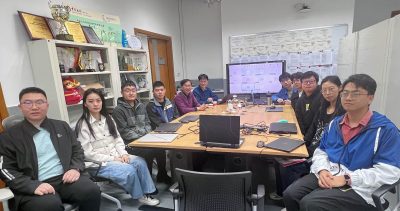
Li Jinlong with members of Prof Wan Feng’s laboratory team
Turning knowledge into impact
For Li, the most rewarding part of his eight years at UM has been the opportunity to turn what he has learned into real, tangible impact. Whether leading the unmanned technology team, organising AI workshops, or developing the RapiLearn AI platform, he has consistently focused on putting knowledge into practice and using technology to address real needs in student life and learning. These experiences have not only fulfilled his early aspiration to serve others through education but have also shaped a broad path for his interdisciplinary growth. Looking ahead, Li hopes to carry this spirit of innovation even further—using technology as a bridge between academic research and societal needs, and contributing to a future that is both smarter and more human‑centred.
Chinese Text: U Wai Ip, Chief UM Reporter Wang Chuyue
Chinese Editor: Gigi Fan
English Text: Translation team
Photo: U Wai Ip, with some provided by the interviewee
Source: My UM Issue 149