
Flavours of home: Stories of UM’s international students
Food is a universal language—an intimate connection that brings people together across cultures. As we enter a season of reunion, we invite you on a flavourful journey. Through the dishes and signature drinks of their hometowns, four University of Macau (UM) international students from Angola, Italy, Timor‑Leste, and Bhutan share the memories and meanings carried in every bite. Their stories offer a glimpse into life far from home and show how diverse cultures continue to thrive and mingle on the UM campus.
Blending the warmth of Macao with the flavours of Angola
In UM’s residential colleges, it is common to see students from all over the world cooking together and sharing moments from their daily lives. In the kitchen of Ma Man Kei and Lo Pak Sam College, Shelcia Teixeira, a second‑year economics student from Angola, is rhythmically pounding steaming cassava paste—funge. With each strike of the muxarico, a traditional Angolan wooden spatula, the scattered cassava gradually blends into a smooth, elastic paste, bringing back memories of her mother’s gentle instructions as she learned to cook at home. Spending this Christmas far from Angola, Teixeira turns to familiar utensils and ingredients to recreate the taste of home, sharing that warmth with friends from around the world.
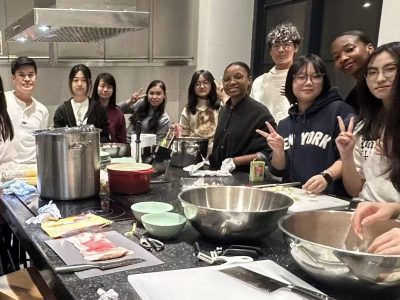
Shelcia Teixeira cooks with fellow students at her college
When Teixeira first arrived in Macao, she depended on the home‑cooked meals made by her aunt—who lives in the city—to ease her homesickness. As she settled on campus, and with her aunt’s encouragement, she began cooking on her own and preparing Angolan dishes. Every weekend, she makes traditional favourites such as Muamba chicken, Calulu fish stew, and chilled Ginguba peanut milk, and shares them with her friends. For Teixeira, cooking is more than simply making food; it is a way of passing down culture. In Angola, the kitchen is where women share wisdom and strengthen family bonds, and now that tradition lives on in the UM college kitchen.
Recreating the flavours of home abroad often requires creativity. When palm oil—an essential ingredient in many Angolan dishes—is hard to find, Teixeira replaces it with olive oil, adjusting her recipes with ingredients she brought from home. She sees this mix of adaptation and tradition as a reflection of Macao’s long history of cultural blending. The dishes may lose some of the richness that palm oil brings, she says, but they gain a touch of local character.
At the recent UM International Food Festival, Teixeira joined other Angolan students to prepare dishes from their home country, filling the campus with the vibrant flavours of Angola. She was also thrilled to take part in the Lusofonia Festival, where Angolan culture and cuisine were prominently showcased, reminding her of the deep connection between her homeland and Macao. As an economics major, Teixeira hopes to contribute to Macao’s role as a platform between China and Portuguese‑speaking countries and help promote Angolan culture.
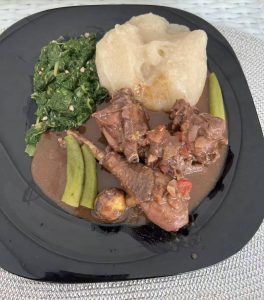
A traditional Angolan dish prepared by Shelcia Teixeira
Everyday memories in the aroma of Italian pasta
For many international students, studying abroad is more than a change of environment—it is a journey of adaptation and growth. When homesickness hits, cooking a familiar dish often becomes the most comforting remedy. For Alessandro Zocchia, who comes from Ferrara, a medieval and Renaissance city in Italy, this journey has been no different. Now studying Chinese law and global legal studies at UM, he often finds comfort in the kitchen of Henry Fok Pearl Jubilee College (HFPJC). There, he stirs a pot of pasta as the aroma of tomatoes and basil fills the room. This simple dish is not just his regular meal in Macao—it is a link to home, carrying cultural memories and moments of personal growth.
‘Food always brings back the warmest memories,’ Zocchia says as he stirs the pasta. ‘When I was a kid, we always had pasta for lunch after school. Every day on my way home, I’d try to guess what kind of pasta and sauce we’d have. That little daily anticipation, the simple ritual of eating together—it’s a very happy memory for me. It also reflects the essence of Italian food culture: family and diversity.’
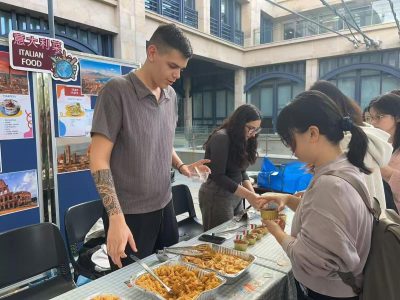
Alessandro Zocchia presents the food he prepared at the UM International Food Festival
‘To me, pasta is the foundation of Italian culture. It looks simple, but it comes in thousands of shapes and pairs with endless sauces. You never get tired of it. In Italy, we eat it almost every day—it really represents the soul of our country.’ Besides pasta, Zocchia also makes gnocchi, and when he gets together with friends, he prepares polpettes, mini pizzas, and desserts like tiramisu and jam tarts. He often cooks with fellow students, enjoying how sharing a plate of hometown flavours brings laughter and a sense of home.
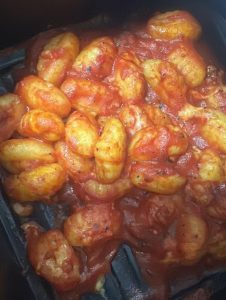
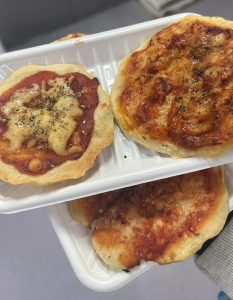
Traditional Italian dishes prepared by Alessandro Zocchia
Ferrara and Macao both have historic centres recognised as UNESCO World Heritage Sites, a connection that makes Zocchia feel especially close to Macao. His decision to study at UM was also inspired by the city’s role as a meeting point between East and West—and the university’s part in that cultural exchange. ‘Studying here allows me to truly immerse myself in a cross‑cultural environment,’ he says.
This year marks Zocchia’s third Christmas in Asia. Instead of preparing a traditional Italian Christmas meal, he plans to spend the holiday travelling from Macao to different parts of Asia to explore cities in China and Southeast Asia and to try festive foods along the way. ‘Of course, I’ll miss the flavours of home and the time with family and friends,’ he says, ‘but I’m excited to experience new tastes and traditions. It feels like learning through food, and that’s why I can turn the Christmas season into a meaningful cultural adventure.’
Brewing the warmth of Timor‑Leste
For many people, coffee is just a quick pick‑me‑up. But for Laura D. A. Aquino Anuno, a student from Timor‑Leste, it holds cultural memories, stories of home, and the spirit of heartfelt hospitality. A first‑year law student who hopes to contribute to Sino‑Portuguese commercial cooperation in the future, Anuno now uses coffee as a bridge to bring the warmth of Timorese hospitality to Macao.
At the Coffee Club in Cheong Kun Lun College, visitors can enjoy not only freshly brewed coffee but also the stories Anuno shares. As one of the club’s cultural ambassadors, she serves coffee from her home while talking about Timor‑Leste’s economic development, the lives of coffee farmers, and the meaning of hospitality in her culture. ‘In our culture, coffee symbolises a welcome. Serving someone freshly brewed coffee is our way of showing respect and warmth,’ she explains. Her grandmother taught her that each cup should be slowly roasted and carefully brewed—a process that reflects patience and sincerity towards the person drinking it.
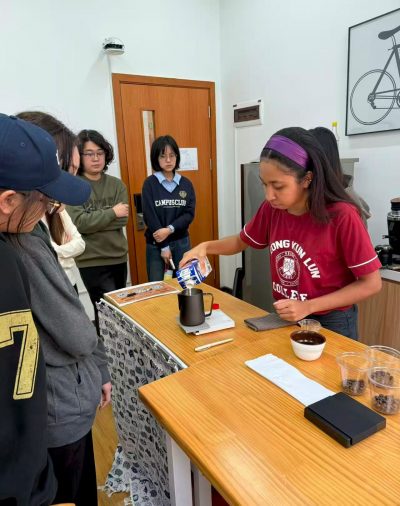
Laura D. A. Aquino Anuno demonstrates her coffee-making skills at the college’s coffee club
For Anuno, the aroma of coffee is like stepping back in time. It brings her to the moments spent at her grandmother’s side, watching her roast and grind beans with the traditional implement lesu. Now, through her work at the Coffee Club, she has learned to combine these traditional practices with modern brewing tools like digital scales and pour‑over kettles to create a blend of heritage and precision.
The reactions from Anuno’s classmates often move her. ‘People are interested not just in how the coffee tastes, but in the culture behind it,’ she says. She has also noticed the differences between the coffee cultures of the two places she calls home. In Timor‑Leste, coffee brings families and communities together; in Macao, it is closely tied to café culture and modern social life. ‘UM gives us a unique space where both cultures can meet. Here, we don’t just coexist—we connect, share, and learn from one another,’ she says.
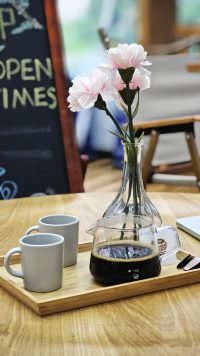
Timorese coffee prepared by Laura D. A. Aquino Anuno
The spice of happiness from Bhutan
The taste of happiness is not always sweet—sometimes it is deliciously spicy. In the kitchen of HFPJC, Vedanth Bhandari, a first‑year statistics and data science student from Bhutan, prepares Datsi. As he chops the Bhutanese chillies his family mailed from home, their sharp, fragrant aroma rises through the room, instantly whetting everyone’s appetite. For Bhandari, each stir of the pot brings back the warmth and memories of Bhutan.
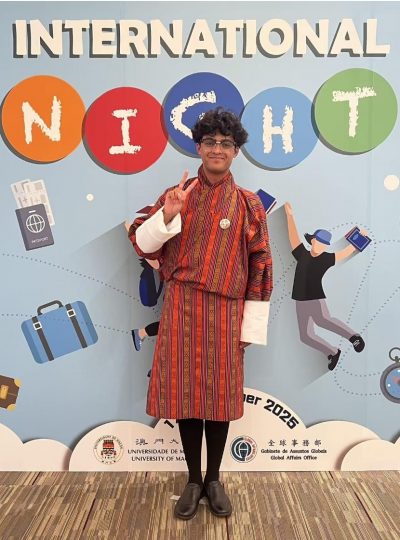
Vedanth Bhandari
‘In Bhutan, chillies aren’t just a seasoning—they’re the main character,’ Bhandari says with a smile. ‘We put our happiness into our food, especially this spicy, fragrant cheese stew.’ He works with confidence and ease. ‘Datsi is actually very simple and flexible. You can make it with potatoes, spinach, or beans—ingredients you can easily find in Macao.’ The only real challenge, he explains, is the chillies. ‘Bhutanese chillies are the heart of the dish. I searched all over Macao and couldn’t find any.’ He tried using Macao local chillies, but the flavour was not quite right. Only when his family mailed him some from home did the familiar taste return. Bhandari recalls that the last time he made Datsi, a fellow student from Macao took one bite, broke into a sweat, and exclaimed that it was ‘delicious and unique’.
When people ask why Bhutanese cuisine uses so much chilli, Bhandari always answers with a smile: ‘In Bhutan, chillies symbolise passion, and cheese represents richness—just like our idea of happiness: simple, warm, and full of flavour.’ As students gather around the steaming pot of Datsi, listening to Bhandari talk about Bhutan’s Gross National Happiness and its snow‑capped mountains and ancient temples, the kitchen becomes a bridge between cultures. In that moment, one spicy stew warms not only the palate but also the connections between people, letting happiness flourish far from home.
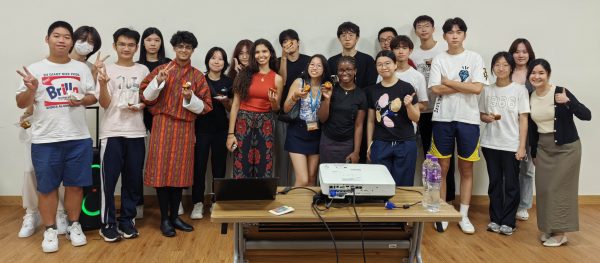
Vedanth Bhandari shares Macao delicacies with fellow students
Bringing the taste of home closer
Food has never been just about keeping us fed. It carries culture, stirs emotions, eases homesickness, and helps students far from home feel a little less alone. In the kitchens of UM’s residential colleges, when students from around the world cook side by side, they create more than flavour—they create shared stories and genuine connections. This winter, let’s follow our senses and embark on a cross‑cultural journey, discovering the unique warmth of a community brought together through food.
Chinese Text: U Wai Ip, UM Reporter Qi Zizheng & Huang Ka Wing, Trainee UM Reporter Li Yayi
Chinese Editor: Gigi Fan
English Text: Translation Team
Photo: provided by the interviewees
Source: My UM Issue 149