WORLD AT UM—From Germany to Macao: Christian Montag’s unconventional research journey
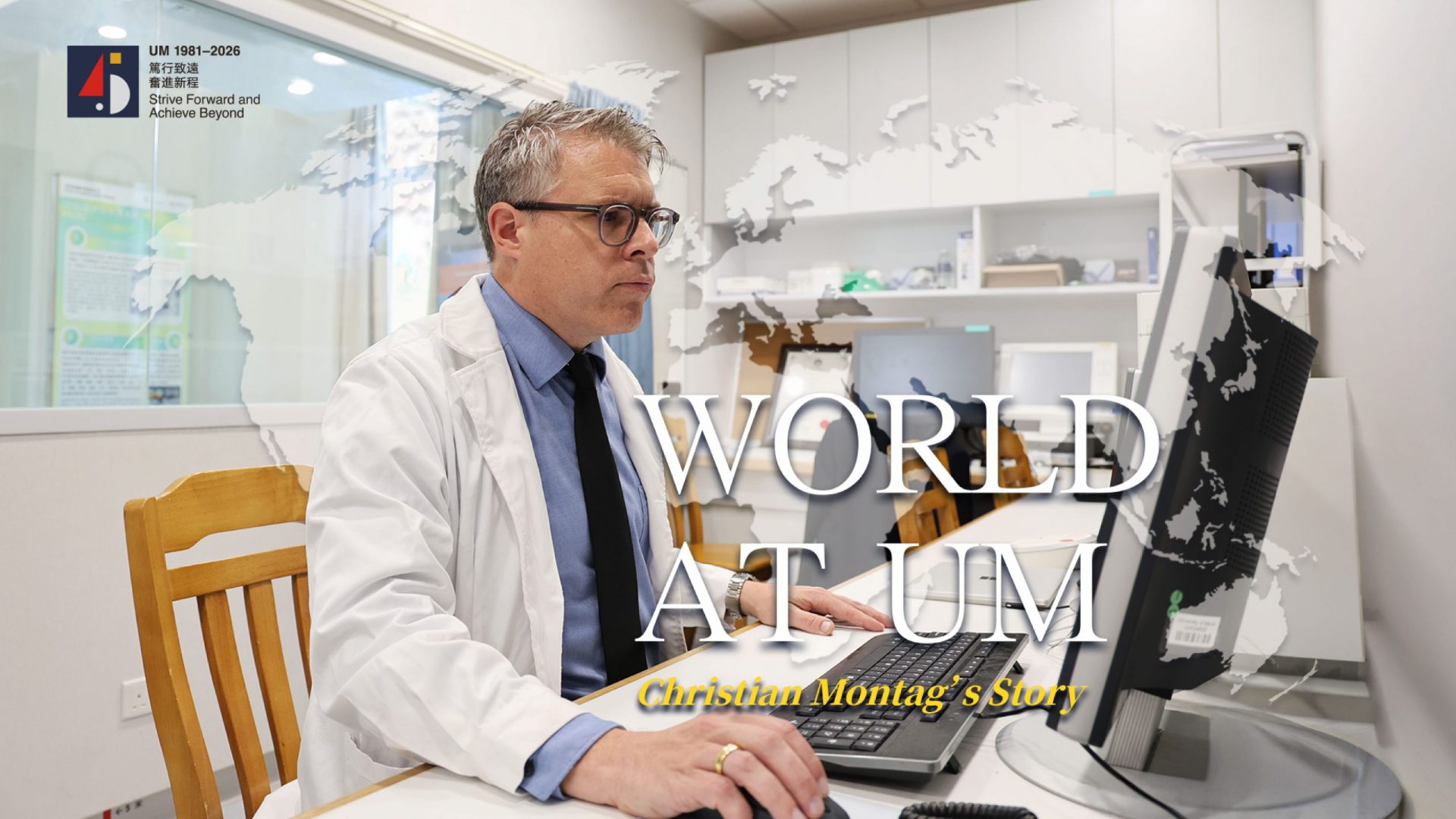
In the global research arena, German psychologist and neuroscientist Christian Montag has set his sights on Macao—a city he sees as an emerging force in scientific innovation. A leading scholar on the impact of artificial intelligence (AI) on human cognition and behaviour, his rise to international prominence has been far from linear. He began his professional life as a bank clerk before making a series of decisive turns that eventually placed him among the world’s top 2% of scientists, according to the Stanford/Elsevier list. Now serving as Distinguished Professor of Cognitive and Brain Sciences and associate director of the Institute of Collaborative Innovation at the University of Macau (UM), Prof Montag leads his team to advance knowledge through sustained inquiry and interdisciplinary collaboration.

Forging a new path in a changing landscape
Prof Montag had been aware of UM before formally joining the university. Encouragement from UM faculty members prompted him to consider embarking on a new chapter in his academic career in Macao. Yet the decision was far from simple. It required stepping away from the security of a tenured professorship and an established life in Germany, as well as leaving behind his elderly parents and other family members. Caught between professional opportunity and family considerations, he weighed the move with great care.
Prof Montag’s deliberations were shaped not only by personal considerations, but also by broader transformations in the academic landscape. As he explains, in recent years, shifts in Europe’s economic climate and tightening research funding prompted him to reassess his long-term plans. Against this backdrop, Macao gradually emerged as a compelling alternative. The city, he observes, shares similarities with his hometown of Cologne—both have populations of around one million and a prominent church as an iconic landmark—offering a measure of familiarity amid change. At the same time, Macao’s multicultural environment provides a wider platform for international academic exchange. UM’s growing community of global scholars, strong interdisciplinary ethos, well-developed research infrastructure, and clear strategic vision reinforced his view of the university as a dynamic and forward-looking institution.
That conviction soon translated into action. In April 2025, Prof Montag officially joined UM and promptly launched a series of cutting-edge research initiatives. At the centre of his work is one of the defining questions of our time: how do intelligent technologies and the human brain shape each other? At the UM Centre for Cognitive and Brain Sciences (CCBS), Prof Montag and his team have pursued this inquiry methodically—from establishing infrastructure and securing ethical approvals to designing rigorous experimental frameworks—laying a solid foundation for their future research in this field.
Beyond theoretical exploration, Prof Montag is equally committed to translating his research into concrete societal applications. As he settled into academic and daily life in Macao, his work began to address local needs more directly. He is spearheading the development of a local cognitive database, with plans over the next two to three years to collect brain imaging data from approximately 300 to 400 participants. By integrating this data with digital phenotyping analysis, the project also aims to assess cognitive health among older adults, generating evidence-based insights to support responses to population ageing while enhancing the precision and timeliness of health monitoring.

Prof Montag is committed to developing a cognitive research database for Macao’s ageing population
Changing course
Interestingly, before turning to brain science, Montag began his career in the banking sector. However, after two years, he realised the role did not align with his deeper aspirations. Determined to change course while still young, he left banking to pursue music. To support himself, he learned web development and founded a small company. Yet even this chapter proved transitional. During a concert tour, a chance encounter with a psychologist ignited a lasting interest in the discipline and redirected his ambitions once again.
In 2004, Montag returned to university to pursue a diploma degree in psychology (equivalent to an MSc). Older than many of his peers, he approached his studies with marked focus and discipline. Within about eight years, he progressed from undergraduate study to postdoctoral research, earning his PhD along the way. In 2011 he completed his Habilitation at the University of Bonn. ‘I knew I was no longer young,’ he recalls, ‘so I became even more focused and single-minded.’
From dismissal to recognition
As a psychologist, Prof Montag became increasingly interested in behavioural deviations and their underlying mechanisms. Drawing on his background in web development and his early observations of the rise of social media, he was quick to recognise a phenomenon that received little serious attention at the time: internet addiction. In the early 2000s, as digital technologies became more deeply embedded in everyday life, related behavioural problems began to surface. He argued that excessive internet use could produce dependency patterns comparable, in some aspects, to those associated with alcohol or nicotine.
On this basis, Prof Montag shifted his research focus from substance use disorders to the study of digital behaviour. Around 2010, he began publishing on internet addiction, but his work was met with considerable scepticism and dismissal. ‘At the time, many people regarded it as nonsense,’ he recalls. Undeterred, he continued refining his theoretical framework and building a robust body of empirical evidence. Over time, his research gained recognition within the academic community. Through a series of studies and monographs, he helped clarify the underlying mechanisms of internet addiction, proposed intervention strategies, and contributed to establishing it as a legitimate field of scholarly inquiry.

Prof Montag has published numerous academic books
Mapping brain health through digital traces
As technology continues to advance rapidly and human behaviour becomes increasingly digitalised, Prof Montag’s research has evolved in tandem. He has devoted considerable effort to applying the concept of ‘digital phenotyping’—a term originally rooted in genetics—to the study of cognition. Within this framework, the behavioural traces people leave in digital environments can be understood as signals that reflect personality traits, habits, and cognitive states.
Building on this foundation, Prof Montag has advanced a forward-looking proposition: patterns in smartphone usage data may provide insights into brain functioning. In particular, he is interested in ‘keystroke dynamics’ —subtle indicators such as typing speed and error frequency—which may serve as digital biomarkers for the early detection of cognitive ageing, although further validation is still required.

Prof Montag conducts neuroscience research related to smart technologies
This line of research is especially pertinent to Macao, where demographic ageing presents growing challenges. The progression from mild cognitive impairment to dementia is often gradual and difficult to detect in its early stages. To address this gap, Prof Montag’s team starts to develop a smartphone application capable of collecting longitudinal behavioural data. The aim is to establish objective, continuous indicators that could enable earlier identification of cognitive decline and improve diagnostic precision.
With an interdisciplinary background spanning neuroscience, psychology, and computer science, Prof Montag also examines the broader cognitive implications of AI. He notes that excessive reliance on AI tools may lead to ‘cognitive outsourcing’, in which certain mental functions are effectively delegated to technology. Over time, this may weaken active thinking and decision-making, potentially leading to the atrophy of underused cognitive capacities. To explore these questions, his team combines behavioural experiments with neuroimaging techniques to investigate how patterns of technology use relate to neural plasticity. Prof Montag notes that UM’s dedicated MRI facility provides a distinct advantage in this regard. ‘Many universities either don’t have an MRI or they have to share such equipment with hospitals,’ he says. ‘Here, we are able to conduct deeper and more sustained investigations.’
A leap worth taking
‘Prepare for the worst, but hold your optimism.’ Prof Montag has drawn this philosophy from his life experiences and it continues to guide him. In addition, a professor’s advice two decades ago left a lasting impression: ‘Treat your work as a project.’ When choosing your next project, he was told, one should not focus solely on financial return, but prioritise those that allow for learning and the creation of meaningful value.
Leaving Germany more than a year ago meant giving up a secure tenured position and a familiar life to start anew in an unfamiliar environment. ‘It was a very difficult decision,’ Prof Montag admits. ‘But after arriving at UM, I truly feel it was worthwhile.’ In his view, the move has brought not only new research opportunities but also a broader perspective. ‘Stepping into new fields inevitably brings uncertainty, but I have always believed in the power of lifelong learning and in discovering new possibilities through change.’

Prof Montag has begun a new chapter of teaching and research at the University of Macau
Beyond the turn
Prof Montag observes that younger generations are unlikely to follow a single, linear career path from start to finish. Instead, success depends on the ability to read changing circumstances, embrace transformation, and seize opportunities as they arise. His own journey stands as a compelling testament to this belief. From bank employee to musician, web developer, and ultimately a leading international scientist, each transition marked not just a change in direction, but a process of rediscovering and reinvention—time and again, finding new possibilities just when the path ahead seemed uncertain.
Today, at the intersection of AI and brain science, Prof Montag continues to break new ground. This spirit of exploration both energises him and drives his persistence. He believes that the future will be shaped by those who dare to try, embrace change, and keep moving forward.

Prof Montag meets with his PhD students to discuss their research progress
Profile of Prof Christian Montag
Prof Christian Montag is Distinguished Professor of Cognitive and Brain Sciences and associate director of the Institute of Collaborative Innovation at UM. Born in Germany, he studied psychology at the University of Giessen before obtaining his PhD and Habilitation at the University of Bonn. Prior to joining UM, he served as Professor of Molecular Psychology at Ulm University and held professorships at the University of Electronic Science and Technology of China (Agreement Professor) and Hamad Bin Khalifa University in Qatar (Adjunct Professor). Prof Montag’s research integrates psychology, neuroscience, behavioural economics, and computer science, with a particular focus on digital phenotyping, mobile sensing, internet use disorder, and the cognitive impact of AI. He has published more than 460 peer‑reviewed articles, authored several academic books, and received numerous awards for excellence in both teaching and research.
Chinese Text: U Wai Ip
Chinese Editor: Gigi Fan
English Translation: Editorial Board
Photo: Editorial Board
Video: Hasen Cai, David Tong, Sam Chan & Senior UM Reporter Long Shuhan
Source: My UM Issue 154