A head start on the future: UM’s comprehensive support for graduates

Graduation season has arrived. For students, graduation marks not only the end of campus life, but also the beginning of a new chapter. Whether they plan to enter the workforce, pursue further study, or start their own business, many graduates face the same question: how can they find a clear sense of direction among so many possibilities?
To support students in further study, employment, and long-term career development, the University of Macau (UM) has established a comprehensive support network. Through the Career Development Centre, residential colleges, faculties, and the Centre for Innovation and Entrepreneurship, UM offers integrated services ranging from career guidance and postgraduate planning to industry engagement and start-up support. This coordinated approach helps students make informed decisions both during and after their studies, enabling them to move forward with confidence and purpose.
Helping students find their direction
For many students, life after graduation can feel uncertain. Deciding what to do next often requires exploration and reflection. To support students at all stages of this journey, UM established the Career Development Centre, which provides a broad range of services covering further study, career planning, and personal development.
In recent years, the centre has offered comprehensive support for both further education and employment. Its initiatives include study preparation workshops, information and experience sharing sessions on overseas postgraduate programmes, job fairs, recruitment talks, workplace experience programmes, and summer internships. Students can also receive personalised support through career assessments, mock interviews, and CV reviews. In the current academic year alone, more than 6,000 students have made use of these services. According to UM’s graduate employment survey, over 85% of graduates have secured employment or progressed to further study within three months of graduation for five consecutive academic years, reflecting the sustained impact of this support.

The UM Career and Internship Fair connects graduating students with prospective employers
This structured and continuous guidance has helped many students identify paths that align with their interests and strengths. One such student is Wong Pui Lam, a fourth-year student in the Department of Portuguese, who recently secured her first full-time position.
Wong began exploring career options early in her university life. Through the Campus Training Programme offered by the UM Student Affairs Office (SAO), she undertook an internship in her first year, gaining practical experience and developing skills beyond her major. ‘The office where I interned was near the Career Development Centre. Out of curiosity, I decided to drop by and speak with the counsellors. Over time, I became more familiar with the activities and resources available,’ Wong recalls.

The Career Development Centre regularly invites companies to deliver specialised career talks
Towards the end of her studies, after completing an exchange programme in Portugal, Wong found herself weighing up further study against entering the workforce. Through a series of in-depth discussions with a career development counsellor at the centre, Wong was able to reflect more clearly on her interests and long-term goals. Gradually, her direction began to take shape. Although she was majoring in Portuguese Studies, she decided to combine her language skills with legal practice and explore opportunities in the field of law. Her plans became clearer after she joined the Alumni Mentorship Scheme, jointly organised by the centre and the UM Alumni and Development Office. Through the scheme, she connected with an alumna working in trade and economics in Brazil, which further strengthened her career aspirations. Now, in her spare time, Wong studies Portuguese law in preparation for her next step. Although she was offered a full scholarship to an overseas university, she ultimately chose to begin her career in Macao in order to gain hands-on experience.

Students from various disciplines participate in the Corporate Experience Scheme
Looking back, Wong emphasises that her decision did not happen all at once. Rather, it developed gradually through ongoing conversations, reflection, and access to various resources. Her experience illustrates the role of the Career Development Centre: not simply a provider of information, but a steady source of guidance that helps students navigate uncertainty and move forward with clarity and confidence.
Cultivating the confidence to guide others
While the Career Development Centre focuses primarily on professional advisory services, UM’s residential colleges (RCs) place greater emphasis on learning through everyday experience and mentorship. At the beginning of each academic year, every new student is paired with a resident fellow for a one-to-one meeting to discuss their interests and potential career paths. These conversations do not end there—students can continue to seek advice and support from their resident fellows throughout their time at university. All UM resident fellows are professionally trained and certified Global Career Development Facilitators (GCDF). Through structured reflection and career exploration, they guide students to clarify their goals step by step. Just as importantly, this approach encourages students to grow into individuals able to support and inspire their peers.
Within this sustained mentoring environment, many students move from uncertainty to clarity—and eventually from being guided to guiding others. Tang Yuan, a fourth-year student in the Faculty of Health Sciences, is one such example. She recently received offers from several leading universities in the US, including Yale University, the University of Notre Dame, and Carnegie Mellon University. In April, she took to the stage to share her journey from early uncertainty to a clearly defined academic goal.
As a member of Cheng Yu Tung College (CYTC), Tang says that college life gave her the freedom to explore different possibilities. She exchanged ideas with students from diverse backgrounds, took on various roles in college activities, and engaged in meaningful discussions with resident fellows. Among these experiences, her regular conversations with CYTC Associate Master Prof Gong Yingxue had a particularly strong influence on her academic planning. Prof Gong’s analysis of different academic and career pathways helped Tang recognise the potential of interdisciplinary development and strengthened her decision to pursue postgraduate study overseas.
With the support of CYTC, Tang gradually moved from being a participant to becoming a mentor herself. For two consecutive years, she served as a teaching assistant in the residential college academic tutorial (RCAT) programme on big data analysis. She also progressed from attending overseas university application seminars to speaking at them, sharing her experiences with younger students. Tang’s journey reflects the distinctive role of the residential colleges in career education: they not only help students find their own direction, but also nurture the confidence and capability to guide others.

Cheng Yu Tung College organises postgraduate application experience-sharing sessions for students, with more than 20 sessions held to date
Connecting students with industry opportunities
For both undergraduate and postgraduate students, turning academic knowledge into practical skills—and ensuring those skills meet industry needs—is crucial when preparing to enter the workforce. In recent years, UM, as a hub for cultivating high-calibre talent in science and technology, has strengthened its collaboration with enterprises across the Guangdong-Hong Kong-Macao Greater Bay Area, further enhancing opportunities for students to engage with industry. The Faculty of Science and Technology (FST), in particular, has taken an active role in expanding career pathways for its students. Through a range of initiatives and industry partnerships, the faculty provides career development opportunities for more than 700 graduates each year on average.
Since last year, FST has organised the ‘UM FST GBA T&E Career and Internship Fair’ in the Guangdong-Macao In-Depth Cooperation Zone in Hengqin, providing students with direct access to employers. The fair features job-matching sessions, CV consultations, mock interviews, and briefings on relevant employment policies. Representatives from relevant organisations are also invited to introduce support measures and internship schemes for Macao youth, helping students better understand both industry expectations and the practical considerations of cross-border career development.
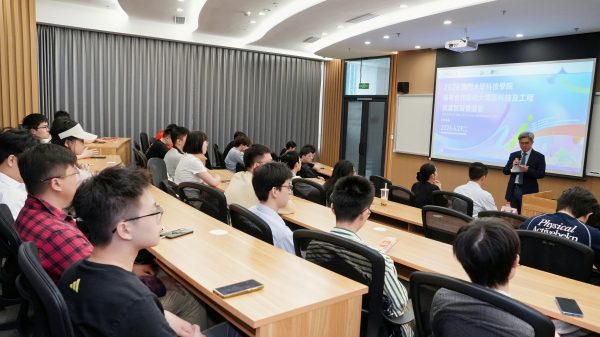
The Faculty of Science and Technology has organised the ‘UM FST GBA T&E Career and Internship Fair’ in the Guangdong-Macao In-Depth Cooperation Zone in Hengqin for two consecutive years
These initiatives have enabled many students to transition more smoothly into the job market. Gao Ruizhe, a postgraduate student specialising in microelectronics, is one such example. After learning about the career fair, she prepared thoroughly for opportunities in the semiconductor and integrated circuit sectors. At the event, she presented her technical expertise with confidence and engaged directly with company representatives. Through these on-site discussions, she successfully secured a job offer. Reflecting on her experience, Gao observes that compared with online applications, face-to-face interaction allows employers to gain a fuller understanding of a candidate’s skills and potential. It also makes the recruitment process more efficient and improves the effectiveness of job matching.

Through the ‘UM FST GBA T&E Career and Internship Fair’, students gain insights into industry needs and explore cross-border development opportunities
According to FST Assistant Dean Prof Lam Chi Chiu, the faculty’s efforts extend beyond organising career fairs. FST also arranges company visits in Hengqin and across the Greater Bay Area, giving students first-hand exposure to industry operations and recruitment needs. These exchanges help foster closer alignment between academic training and market demand, while further expanding graduates’ career horizons.
Supporting innovation from laboratory to market
Alongside further study and employment, entrepreneurship is increasingly becoming an attractive option for graduates. Since its establishment in 2017, the UM Centre for Innovation and Entrepreneurship (CIE) has supported students and alumni in turning research ideas into viable ventures. To date, CIE has provided nearly MOP 20 million in start-up funding and incubated more than 70 companies. Teams nurtured by the centre have won over 180 awards in innovation and entrepreneurship competitions. Together, these achievements reflect a growing ecosystem that supports projects from early-stage research through to commercial development.

The Centre for Innovation and Entrepreneurship regularly invites experts from various fields to enhance the entrepreneurial capabilities and practical knowledge of faculty members and students
CIE works closely with the University of Macau Advanced Research Institute in Hengqin (HUMRI) to run a parallel incubation model, enabling start-ups to establish a presence in both Macao and Hengqin. By leveraging the complementary strengths of both places—including policy support and industrial resources—the centre promotes the model of ‘R&D in Macao, technology transfer in Hengqin’, accelerating the process of bringing research outcomes to market.
With this structured support in place, many research projects have successfully progressed beyond the laboratory. One example is UM doctoral student Koc Ho Cheng, who co-founded MacOrigen, a company focused on applying stem cell technology in the medical and biotechnology sectors.
Under the guidance of her supervisor Prof Chen Guokai, Koc, who specialises in stem cell research, began exploring the practical potential of her work. This exploration gradually evolved into an entrepreneurial vision. In the early stages of the venture, she and her team secured start-up funding from CIE, enabling them to complete the proof-of-concept phase. With continued guidance from CIE, the team took part in start-up competitions and roadshows, refining their technology while developing a clearer understanding of market demand.
As the project expanded into the Greater Bay Area, cross-border operations brought new legal, tax, and regulatory challenges. CIE provided legal and financial advisory support, helping the team identify risks and adjust their strategy. With further backing from HUMRI, Koc and her team eventually formed a partnership with an enterprise in Hengqin. This collaboration enabled the technology to be put into practice, marking an important step from academic research to practical application.

Through the ‘UltiMater’ innovation and entrepreneurship exhibition, UM provides a platform for faculty and student start-ups
Empowering graduates to forge their own path amid uncertainty
In a rapidly changing world, career development is no longer confined to a single, linear path. From personalised career guidance and residential college mentorship to industry partnerships and entrepreneurial support, UM provides a broad spectrum of opportunities and initiatives to help students navigate the transition from university to the wider world.
The journeys of these students illustrate that clarity rarely comes all at once; rather, it emerges gradually through sustained guidance, practical experience, and thoughtful reflection. With access to the right support and opportunities, students are able to make informed choices and pursue their ambitions across a range of fields. By bringing together institutional resources and real-world engagement, UM aims to equip its graduates not only with knowledge and skills, but also with the confidence to chart their own course—and to step into the future with purpose.
Chinese Text: U Wai Ip
Chinese Editor: Gigi Fan
English Translation: Bess Che
Photo: Editorial Team
Source: My UM Issue 154