Li Degui: In search of economic meaning through econometrics
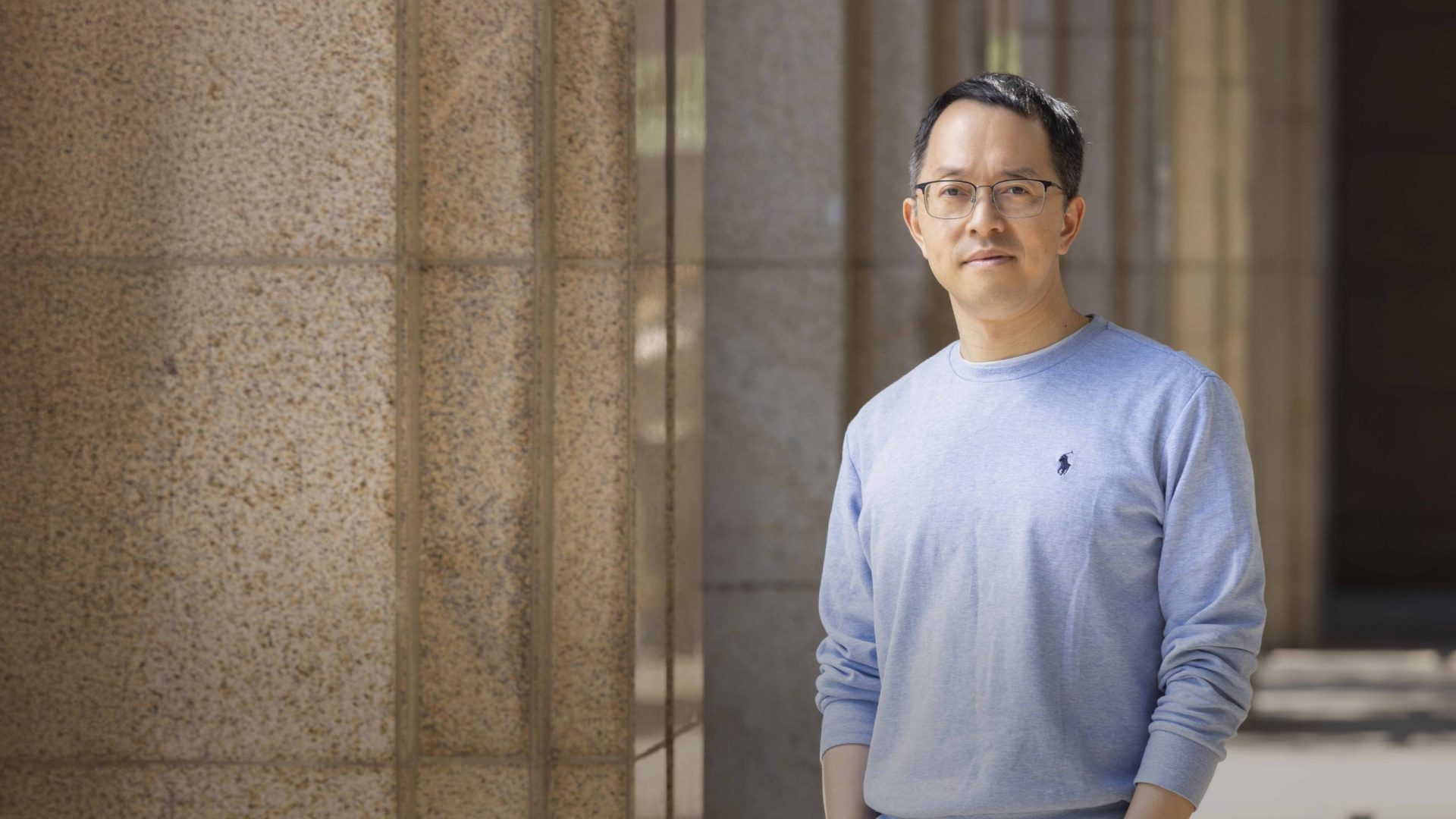
Li Degui is an econometrician with a deep mathematical foundation and an academic career spanning three continents. Over more than two decades, he has developed a comprehensive set of econometric tools to better understand an increasingly complex world. His research addresses frontier challenges in high-dimensional, time-varying, and functional time series analysis, guided by a consistent belief that meaningful innovation begins with a solid foundation. At the University of Macau (UM), Prof Li has put this philosophy into practice, starting with reforms in the foundational training of doctoral students. He is deeply committed to cultivating a new generation of scholars capable of independently identifying and solving real‑world problems. Prof Li’s story is not only one of rigorous scholarly inquiry, but also a testament to his sustained pursuit of academic excellence, educational responsibility, and a thoughtful balance between professional ambition and family commitment amid the demands of intercontinental mobility.
Navigating a complex world with econometrics
In an era defined by data abundance and constant change, economic, financial, and political systems no longer evolve along stable or predictable paths. Markets respond in real time, risks propagate rapidly, and traditional economic models—designed for more static conditions—often struggle to keep pace. Against this backdrop, Prof Li has spent more than two decades grappling with a fundamental question: how can reliable guidance be extracted from complex, fast‑changing economic and financial data? His answer is an ambitious one. He envisions a new generation of econometric tools that function like intelligent navigation systems—capable of sensing risk, detecting change, and supporting informed decision‑making in uncertain environments. This vision has drawn him to the frontier of complex time-series econometrics.
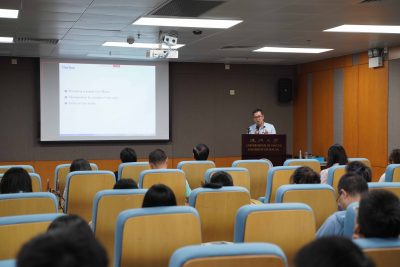
Prof Li delivers a lecture at the UM Scholar Research Forum
At the core of his research are three closely interconnected challenges. The first concerns high‑dimensional, non‑stationary time series, where meaningful patterns must be identified from vast and complex datasets. The second focuses on matrix time series, which capture the evolving interactions within complex systems. The third addresses functional time series, aiming to extract trends and risk signals from continuous data streams, such as stock price curves. Together, these approaches form integrated complex time-series econometrics modelling framework that enables Prof Li to translate real‑world complexity into measurable, interpretable, and actionable insight.
What began during Prof Li’s doctoral studies has since matured into a coherent theoretical framework. Its significance was recently recognised through support from the National Natural Science Foundation of China (NSFC) Young Scientist Fund (Category A), which is intended to strengthen the framework’s theoretical foundations while expanding its practical applications. For Prof Li, this support represents not only recognition of his past achievements, but also an opportunity to focus more fully on tackling challenging research problems at UM and transforming theoretical blueprints into practical tools.
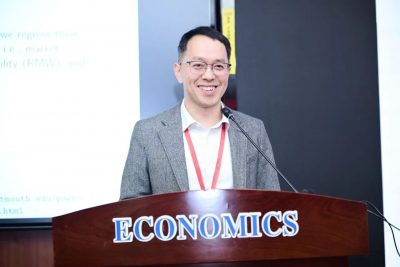
Prof Li during his doctoral studies at Zhejiang University
An academic journey across three continents
Prof Li’s academic life has unfolded much like a time series of its own. His journey began in 1999, when he entered the Department of Mathematics (now the School of Mathematical Sciences) at Zhejiang University. Over the following nine years, he underwent rigorous mathematical training, earning his PhD in 2008 and laying the analytical foundation that would later underpin his work in econometrics. After completing his PhD, Prof Li made a deliberate decision to enrich his academic experience overseas. Together with his fellow graduate student Chen Jia—who would later become his wife—he shared a strong view that international experience was is essential to scholarly development. The couple moved to Australia to begin postdoctoral research, stepping into an unfamiliar academic and cultural environment.
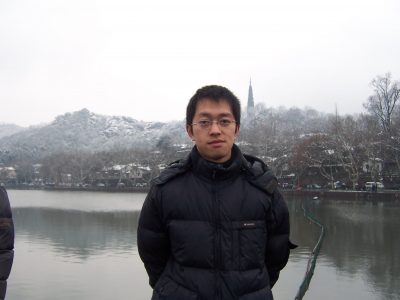
李德櫃取得浙江大學數學系博士學位
The transition, however, was far from effortless. Language barriers and cultural differences soon emerged as significant challenges. ‘For most Chinese scholars, the real challenge often lies in language and communication,’ Prof Li acknowledges. Rather than allowing these obstacles to slow his progress, he faced up to them directly. He actively sought teaching opportunities, beginning with problem‑solving sessions and tutorial classes, and gradually moving on to teaching undergraduate courses.
At the same time, his research was gaining increasing recognition. In 2011, Prof Li was awarded the Discovery Early Career Researcher Award (DECRA) by the Australian Research Council, a grant that marked a turning point in his postdoctoral career. Reflecting on this period, he notes, ‘Those two years were crucial.’ The financial independence provided by the grant translated into greater academic freedom, allowing him to attend more international conferences, visit universities around the world, and build a global network of collaborators. ‘Many of my subsequent important collaborators were people I met during those one or two years,’ he says.
Prof Li later accepted a lectureship position in the Department of Mathematics at the University of York in the UK, a position equivalent to an assistant professorship. Meanwhile his wife Chen Jia took up a post at the same institution (but in a different department). During their time in Australia, the couple had been based at Monash University and the University of Queensland respectively, a two‑hour flight apart. At York, they were finally able to live and work in the same city, bringing a long‑awaited sense of stability to both their professional and personal lives.
During his years at the University of York, Prof Li’s career advanced rapidly. Building on the foundation laid during his PhD and postdoctoral training, he was promoted to professor in fewer than five years. Alongside his research achievements, he became increasingly involved in departmental service and academic management—experiences that would later shape his approach to research development and academic leadership.
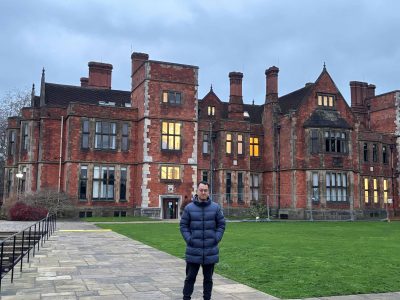
Prof Li discusses the mysteries of time series with UM faculty and students
A new academic beginning, grounded in family
In 2024, Prof Li and his wife, Chen Jia, made the decision to leave the UK and join UM. The move marked not only a new chapter in their academic careers, but also a recalibration of personal priorities. As their parents grew older, the desire to be closer to family became an increasingly important consideration. Beyond these personal reasons, UM also offered a compelling academic environment. ‘UM has a unique location, providing stable local support and the ability to apply for research funding from the Chinese mainland, giving it a unique advantage,’ Prof Li explains.
At the same time, Chen Jia was appointed as a professor in the Department of Economics in UM’s Faculty of Social Sciences through global recruitment. The opportunity for both scholars to continue developing their research and teaching at the same institution proved decisive. For the couple, the move represented not only parallel professional advancement, but also a renewed alignment between academic ambition and family life.
Prof Li now serves as Associate Dean (Research and Development) of the Faculty of Business Administration (FBA), where he plays an active role in guiding the faculty’s strategic development. In addition, he has been involved in refining faculty evaluation mechanisms and establishing clearer, more rigorous standards, with the aim of attracting promising young scholars and strengthening FBA’s overall research capacity.
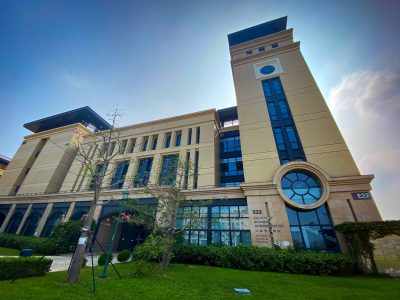
Prof Li currently serves as Associate Dean (Research and Development) of the UM Faculty of Business Administration
Based on his own experience of receiving a Category A grant from the NSFC Young Scientist Fund last year, Prof Li is confident that more faculty members will secure similar fundings in the years to come. He explains, ‘As the collective effect of research takes shape, UM will have greater potential to establish a significant academic reputation in the Asia‑Pacific region in the fields of business and economics.’ He also emphasises the collaborative nature of this ambition: ‘This is not something that can be achieved by one person alone, but by the collective effort of the entire faculty together’
From research rigour to educational practices
Throughout his research career, Prof Li has been guided by a principle: intellectual difficulty is often a measure of scholarly value. ‘If a research project requires no effort and can be completed easily, it is probably not a particularly valuable topic. It has likely already been studied by others,’ he explains. This view took shape early in his postdoctoral years in Australia, where the challenges he encountered extended well beyond language and cultural differences. The persistent difficulties he faced in research, he recalls, were precisely what signalled that he was working on problems of genuine depth and originality.
These experiences reinforced Prof Li’s belief that meaningful progress in research builds on sustained theoretical and methodological preparation. ‘Without a solid foundation, even if you find a problem worth of studying, you may not know where to start, or you may only see the surface,’ he explains. This understanding now directly informs his approach to doctoral training at UM. Beginning this year, FBA requires all doctoral students to complete a structured programme of core coursework in their first year, explicitly treating foundational training as the cornerstone of independent research capability development.
To support this shift, many of the doctoral courses offered by FBA this year have been newly developed. Prof Li himself played an active role in this process. ‘I participated directly in the planning and teaching of two doctoral courses in econometrics,’ he notes.
In Prof Li’s view, such training fundamentally shapes how young scholars approach research direction. ‘New doctoral students may have many ideas, but not every idea is feasible. A solid foundation allows for significantly greater flexibility in adjusting the scope and depth of their subsequent research,’ he says.

Prof Li shares the mysteries of time series with UM teachers and students.
He identifies two common paths students tend to follow: pursuing trending topics with many active researchers, or tackling long‑standing and difficult problems whose rewards may take longer to materialise. Whichever path they choose, Prof Li stresses that a solid foundation is indispensable. ‘Ultimately, originality stems from knowledge buildup,’ he says. ‘We always hope that students’ research will be distinctive. Without sufficient foundational training, their results are more likely to resemble existing work and lack true novelty.’
From global experience to future vision
Prof Li embodies many of the defining characteristics of Chinese scholars of his generation: a strong foundation in mathematics and/or physics, an international academic outlook, a diligent and pragmatic approach to research, and a commitment to continuous learning. His academic journey—from China to Australia and the UK, and ultimately to Macao—has immersed him in diverse academic and cultural environments, shaping an open and inclusive perspective. He believes that this background is makes him particularly well suited to working and living in Macao, a place where Eastern and Western traditions co-exist harmoniously. Looking ahead, Prof Li sees this new phase as an opportunity for collective advancement. ‘I hope that through the efforts of our generation, we can build a solid academic reputation for the Faculty of Business Administration in the Asia‑Pacific region and contribute more broadly to the academic development of UM,’ he says.
Profile of Prof Li Degui
Prof Li Degui is Distinguished Professor of Business Economics and Associate Dean (Research and Development) in the Faculty of Business Administration at the University of Macau. He is also a team leader in financial econometrics at the UM Asia‑Pacific Academy of Economics and Management. His academic career spans Europe, Australia, and Asia. Prior to joining UM, Prof Li held teaching and research positions at the University of York in the UK and at several leading universities in Australia. Prof Li’s research is situated at the forefront of econometrics, with a focus on time series analysis, panel data modelling, and machine learning. He has published extensively in leading international journals, including the Annals of Statistics, Journal of the American Statistical Association, and Journal of Econometrics. His work has been recognised with several prestigious awards, among them the Discovery Early Career Researcher Award from the Australian Research Council, the Leverhulme Research Fellowship in the UK, and the National Natural Science Foundation of China Young Scientist Fund (Category A). He currently serves as a Co‑Editor of Econometric Theory and an Associate Editor of Journal of Time Series Analysis.
Chinese Text: U Wai Ip, UM Reporter Tian Minyu & Trainee UM Reporter Wang Yanling
Chinese Editor: Gigi Fan
English Translation: Bess Che
Photo: Jack Ho, with some provided by the interviewee
Source: My UM Issue 151