Beyond books: Xu Hong’s vision for a library of creation and innovation
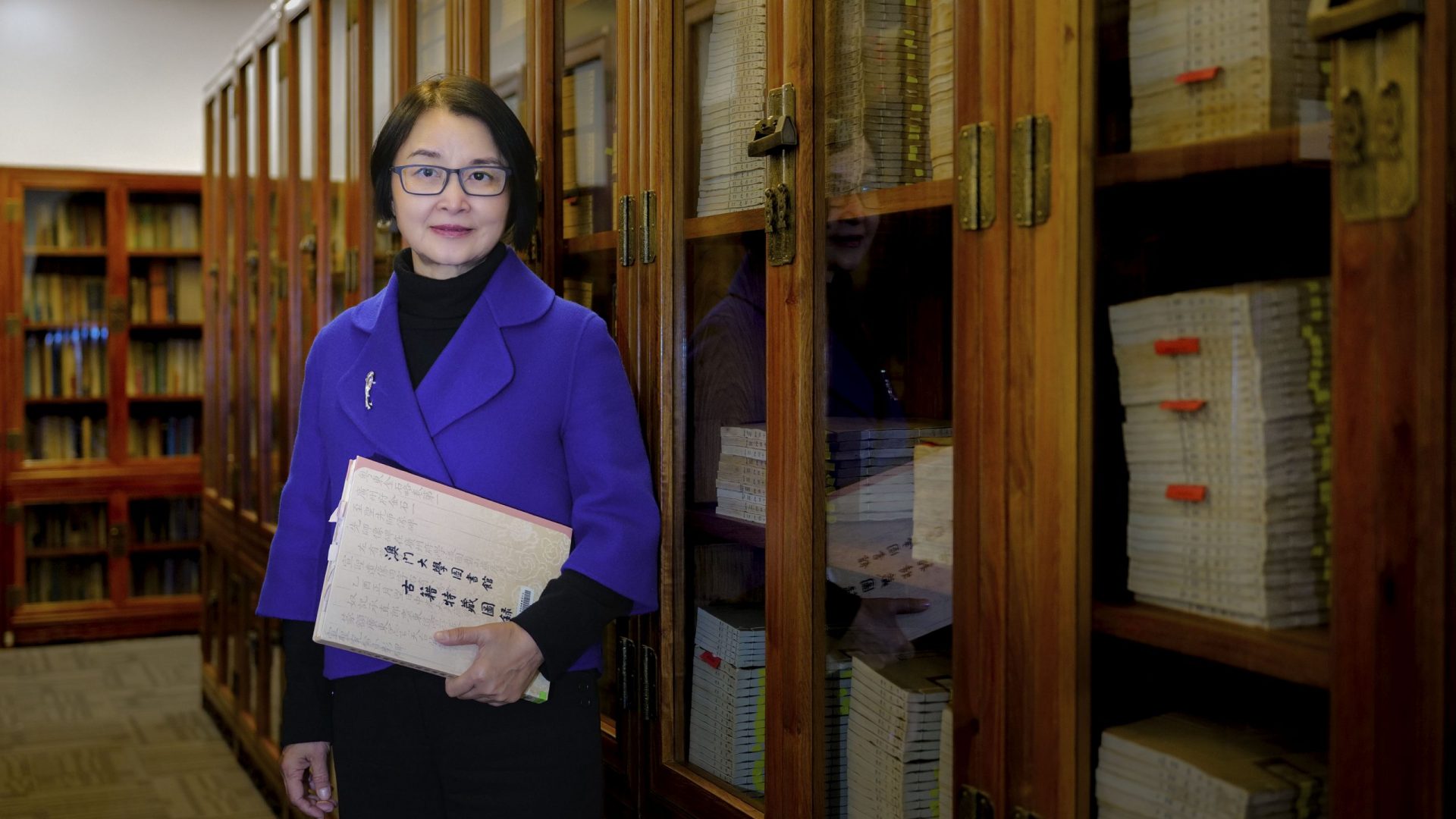
As print media continues to give way to digital formats, university libraries are redefining their role in the academic community. Prof Xu Hong, University Librarian at the University of Macau (UM), embodies nearly forty years of academic and professional experience across universities in China and the US. Since assuming her position at UM, she has embraced the spirit of ‘serving as a stepping stone’, working behind the scenes to support the success of faculty and students. She views the UM Library as a living organism—one that must grow and adapt alongside the university. As a steward of knowledge, she is committed to bridging traditional collections with an evolving digital landscape, shaping a library that remains both relevant and forward-looking.
Curating knowledge: An approach to library management
‘The core mission of a university library has never changed. It is to support research and teaching,’ Prof Xu says with clarity and conviction. Her journey—from student to lecturer and ultimately to University Librarian—across decades of study and leadership experience in universities across China and the US, has given her a nuanced understanding of the varied expectations of faculty and students. It has also shaped her conviction that a university library is not a one‑size‑fits‑all repository, but a specialised service platform responsive to diverse academic needs.
Since joining UM as University Librarian, Prof Xu has articulated a clear dual mission for the library. As a public university library, the UM Library serves both as the academic backbone of the institution and as a gateway to diverse cultures and ideas for the wider community. Library collections must therefore sustain advanced research while also preserving and promoting cultural heritage at both the local and regional levels. This commitment is reflected in distinctive documents, periodicals, and popular works that highlight cultural exchanges among Guangdong, Hong Kong, and Macao, as well as between China and the wider world. In this way, the library serves multiple constituencies, enabling faculty members, students, and members of the public alike to access resources—and spaces—that support their intellectual pursuits.
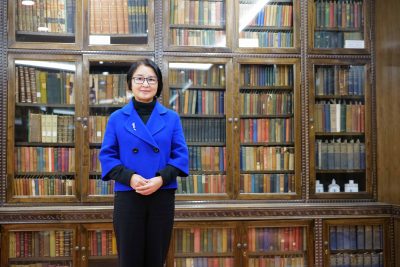
Prof Xu is dedicated to building the library into a vibrant knowledge space where faculty and students want to visit, enjoy spending time in, and feel inspired to create
Translating this philosophy into practice requires alignment across every dimension of the library’s operations. From resource acquisition and space planning to cataloguing and reference services, each function is guided by the university’s broader development strategy. For Prof Xu, this also redefines the professional identity of librarians. Beyond technical expertise, they must cultivate cultural awareness, communication skills, and interdisciplinary insight to engage an increasingly diverse academic community.
‘Librarians are no longer mere custodians of books, but curators of knowledge,’ Prof Xu says. ‘They should make the library a place people want to visit, enjoy spending time in, and feel inspired to create.’ Under her leadership, the UM Library has gradually shifted from an emphasis on collection‑building alone toward a broader commitment to enabling creativity and knowledge creation.
Navigating the crossroads of disciplines
Prof Xu grew up surrounded by books. Yet what ultimately drew her to library science was not simply a love of reading, but a deeper intellectual curiosity: How is knowledge organised, discovered, and put to use? ‘At first, I thought library science was just about organising books,’ she recalls with a smile. ‘But later I realised that it is the navigation system for knowledge.’
Prof Xu completed her bachelor’s degree in Library Science at Wuhan University, where her training extended beyond document classification and cataloguing to include advanced mathematics and the basic sciences. This interdisciplinary foundation equipped her with both scientific rigour and humanistic sensitivity, enabling her to communicate confidently across diverse academic communities. During her master’s studies, her focus shifted from practice to theory and history. By examining the contrasts and convergences between traditional Chinese book‑collecting practices and Western public library models, she began to see library science not merely as a technical field, but as a discipline deeply embedded in cultural and social contexts. It was during this formative period that she encountered the work of library science pioneer Frederick W. Lancaster, particularly The Measurement and Evaluation of Library Services and Toward Paperless Information Systems. His pioneering research in evaluation and information systems broadened Prof Xu’s perspective on the evolving role of libraries and inspired her to pursue doctoral studies in the US.

Prof Xu during her doctoral studies at the University of Illinois at Urbana‑Champaign
At a time when doctoral programmes in library science were still developing in China, Prof Xu chose to continue her studies at the University of Illinois at Urbana‑Champaign under Lancaster’s mentorship. There, she received rigorous training in research methods, statistics, and educational psychology. More importantly, she deepened her understanding of how different types of libraries—especially university libraries—serve distinct user communities, from engineers and medical students to scholars in the arts and humanities. This experience expanded her earlier expertise in information retrieval into a more comprehensive vision of resource architecture and service design. It also reinforced her conviction that an effective librarian must be a ‘generalist knowledge architect’, positioned at the intersection of disciplines.
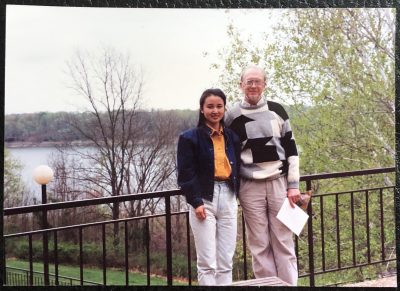
Prof Xu with her mentor, Prof Lancaster
‘You can’t just know about libraries,’ Prof Xu emphasises. ‘You also need to understand science, literature, technology, education—even psychology. You don’t need to be an expert in every field, but you do need to understand the world your readers inhabit.’ For Prof Xu, the true strength of librarians lies in standing at the crossroads of disciplines—connecting resources, anticipating needs, and enabling discoveries. It is a perspective she now encourages in her students, urging them to broaden their intellectual horizons and cultivate the integrative thinking required in an increasingly complex academic landscape.
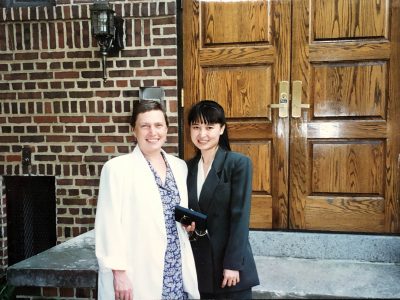
Prof Xu with the dean of the Graduate School of Library and Information Science at the University of Illinois after successfully defending her doctoral dissertation
In tandem with the university
When Prof Xu assumed the role of University Librarian at UM in March 2025, she began by listening—visiting faculties and residential colleges across campus with a notebook in hand. Together with her team, she prioritised understanding the needs of faculty and students before introducing new initiatives. This deliberate process of consultation laid the groundwork for putting her management philosophy into practice.
In Prof Xu’s view, the library is not a protagonist on the academic stage, but an indispensable pillar working behind the scenes. To perform this role effectively, the library must be closely aligned with the university’s disciplinary structure and strategic priorities. With this in mind, she initiated a series of in‑depth consultations, holding face‑to‑face meetings to gather feedback on collections, spaces, and services. Her objective was not merely to ensure that resources were available, but to ensure that they were relevant, accessible, and fully utilised. At the same time, she strengthened electronic holdings and expanded interdisciplinary collections to better support emerging fields and evolving research needs.
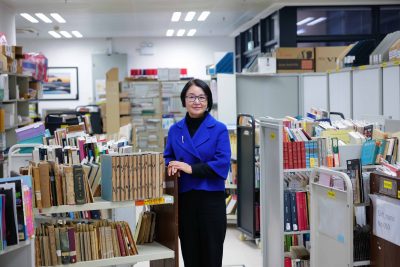
Prof Xu currently serves as the University Librarian at UM
Listening, however, was only the first step. Prof Xu also launched a comprehensive benchmarking initiative to evaluate how effectively the library’s print and digital resources support research and teaching. By comparing UM’s collections and services with those of leading international universities, as well as major institutions in the Chinese mainland, Hong Kong, and Macao, she sought to move beyond the question of ‘Do we have enough?’ toward deeper considerations of usability, integration, and future readiness.
As UM enters a new phase of high‑quality development—with rising international rankings, campus expansion, and increasingly dynamic interdisciplinary research—Prof Xu believes the library must evolve in tandem. Rather than remaining a passive support unit, it should act as an active enabler: a dynamic ‘knowledge catalyst’ that connects disciplines, fosters dialogue, and strengthens internationalised teaching and research. In parallel, librarians themselves must grow from resource managers into academic partners, shifting from reactive service providers to proactive collaborators.
‘On this stage, we may be a supporting role,’ Prof Xu says with a smile, ‘but the preparation and dedication of the supporting role often determine the quality of the entire performance.’ For Prof Xu, understanding the rhythms of academia and anticipating the needs of its community are what enable the library to serve as the university’s most steadfast backbone.
AI as a catalyst for library transformation
As artificial intelligence (AI) reshapes the global academic landscape, digital transformation has become imperative for university libraries. For Prof Xu, this shift is strategic: if the UM Library is to remain the university’s academic backbone, it must evolve beyond traditional collections and services into a proactive partner supporting digital scholarship and research.
Prof Xu often cites an observation from Times Higher Education that ‘many academic librarians are now transforming from resource managers to digital curators.’ Building on this idea, she explains: ‘We are not only curating digital content, but also services, spaces, and experiences. The true value of a library lies in integrating resources, responding to users’ needs, and guiding inquiry.’
This perspective has prompted a reassessment of how the library measures its impact. Rather than relying primarily on circulation statistics or collection size, the UM Library now examines deeper indicators: who is using its resources, how they are being applied, and in what academic contexts. Prof Xu closely monitors electronic resource usage, engagement with data analysis tools, and activity within the institutional repository, treating these patterns as signals of how fully the library is embedded in research and teaching practices.
Technological adoption is therefore guided by purpose. Since last year, the library has piloted AI‑enabled functionalities within major academic databases to support literature reviews, research mapping, and paper structures. These tools are designed not to replace critical thinking, but to streamline routine processes, allowing researchers to devote greater energy to originality and analytical depth. In this sense, AI is an enabler of intellectual work rather than a substitute for it.
The same philosophy informs the library’s outward-facing initiatives. Under Prof Xu’s leadership, the UM Library will co‑organise the ‘Beyond Boundaries: New Modes of Access and Accessibility through Emerging Technologies Symposium’ in collaboration with two sections—the Information Technology Section and the Asia Oceania Regional Division—of the International Federation of Library Associations and Institutions (IFLA). The symposium will explore how immersive technologies such as VR, AR, and MR—together with AI—can expand access to knowledge and reimagine scholarly engagement. As the first international conference UM co‑hosts with IFLA, the event signals the library’s growing global presence and its commitment to shaping conversations about the future of access and accessibility.
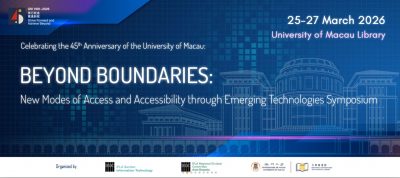
UM will host the ‘Beyond Boundaries: New Modes of Access and Accessibility through Emerging Technologies’ symposium in March
Closer to campus, Prof Xu has also advanced digital curation through collaboration with the UM Museum of Art. Working with Prof Li Jun, head of the Department of Arts and Design, she co‑curated the exhibitions ‘Regarding Books’ and ‘A Tree of Knowledge: Creation Based on Greatness’. The accompanying e‑book Regarding Books extends the exhibition into the digital realm, presenting rare Chinese and Western works—from manuscripts and woodblock prints to modern publications and maps—drawn largely from the UM Library’s collections. Spanning from 1491 to the late 20th century and encompassing multiple languages, the project demonstrates how technology can renew the visibility and relevance of historical materials.
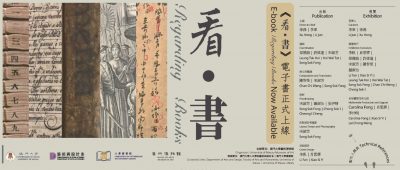
Prof Xu collaborates with Prof Li Jun to compile the e-book Regarding Books
‘The library is transcending its traditional role,’ Prof Xu says. ‘It is no longer merely a quiet reading space, but a dynamic hub that sparks creativity, fosters dialogue, and nurtures diverse cultures—and AI is precisely the catalyst for this transformation.’
A dual‑campus vision for the library
Before formally assuming her role as University Librarian, Prof Xu was entrusted with an important task: taking part in the design review of the library for UM’s new campus in the Cooperation Zone in Hengqin. The new facility, planned across three floors and covering approximately 9,000 square metres, has been designed with future academic development in mind. Its layout and functional planning aim to provide integrated support for teaching, research, and innovation.
Prof Xu has outlined a clear and complementary positioning for the university’s two libraries. The main campus library serves a dual function: as an ‘academic outpost’ and an ‘academic accelerator’. As an academic outpost, it safeguards the university’s scholarly depth, housing rare books and special collections while maintaining comprehensive resources across disciplines including science, business, the humanities, law, and education. As an academic accelerator, it provides centralised support—such as resource development, collection organisation, and information management—for the Cooperation Zone campus. It also strengthens user services and teaching support in response to the growth of newly established disciplines such as engineering, medicine, information science and computing, and design.
The Cooperation Zone library, by contrast, is conceived as a more flexible and future‑oriented space. Equipped with advanced digital infrastructure, it can accommodate AI‑enabled services and immersive technologies. The spatial design prioritises adaptability, featuring collaborative and multifunctional areas that can evolve alongside new teaching models and research practices.
Serving as a stepping stone
The spirit of ‘serving as a stepping stone’—working quietly and diligently behind the scenes to support the success of others—remains central to Prof Xu’s leadership. Through the library’s resources, services, and dedicated team, she seeks to foster the academic growth of faculty and students, strengthen the university’s disciplinary development, and respond to the cultural needs of the wider community. In doing so, the library becomes not merely a repository of knowledge, but an active platform for scholarly exchange and innovation. This philosophy echoes the words of Shiyali Ramamrita Ranganathan, widely regarded as the father of library science: ‘The library is a growing organism.’ For Prof Xu, this principle underscores the need for continual renewal. By remaining attentive to the evolving needs of UM’s academic community, anticipating emerging fields of inquiry, and aligning its development with the university’s broader direction, the library can extend its influence beyond its physical walls and sustain meaningful growth.
Profile of Prof Xu Hong
Prof Xu Hong is the University Librarian of the University of Macau. She holds a PhD in Library and Information Science and an MS in Educational Psychology from the University of Illinois at Urbana‑Champaign, as well as a BA and MA in Library Science from Wuhan University. Before joining UM, Prof Xu held senior leadership positions across leading international institutions. She served as University Librarian at Duke Kunshan University, Associate University Librarian at Duke University, Associate University Librarian at City University of Hong Kong, and head of the East Asian Library at the University of Pittsburgh. She has also held academic appointments at universities in both China and the US.
Prof Xu’s research interests include library architecture and space planning, library management, information organisation, and bibliometrics. She currently serves as a standing committee member of the IFLA Library Buildings and Equipment Section, vice chair of the China Library Association’s Building and Equipment Committee, and vice chair of the Council of the Guangdong–Hong Kong–Macao University Library Alliance. She is the founding executive director of the Society of Chinese Scholarly Librarians and serves on the editorial boards of several academic journals in China and internationally.
Chinese Text: U Wai Ip, UM Reporter Yang Ruiqi, Trainee UM Reporter Li Yayi & Wang Yanling
Chinese Editor: Gigi Fan
English Translation: Gloria Kuok & Bess Che
Photo: UM Reporter Yang Ruiqi, with some provided by the interviewee
Source: My UM Issue 151