UM honorary doctor Gong Qihuang: Illuminating science and education
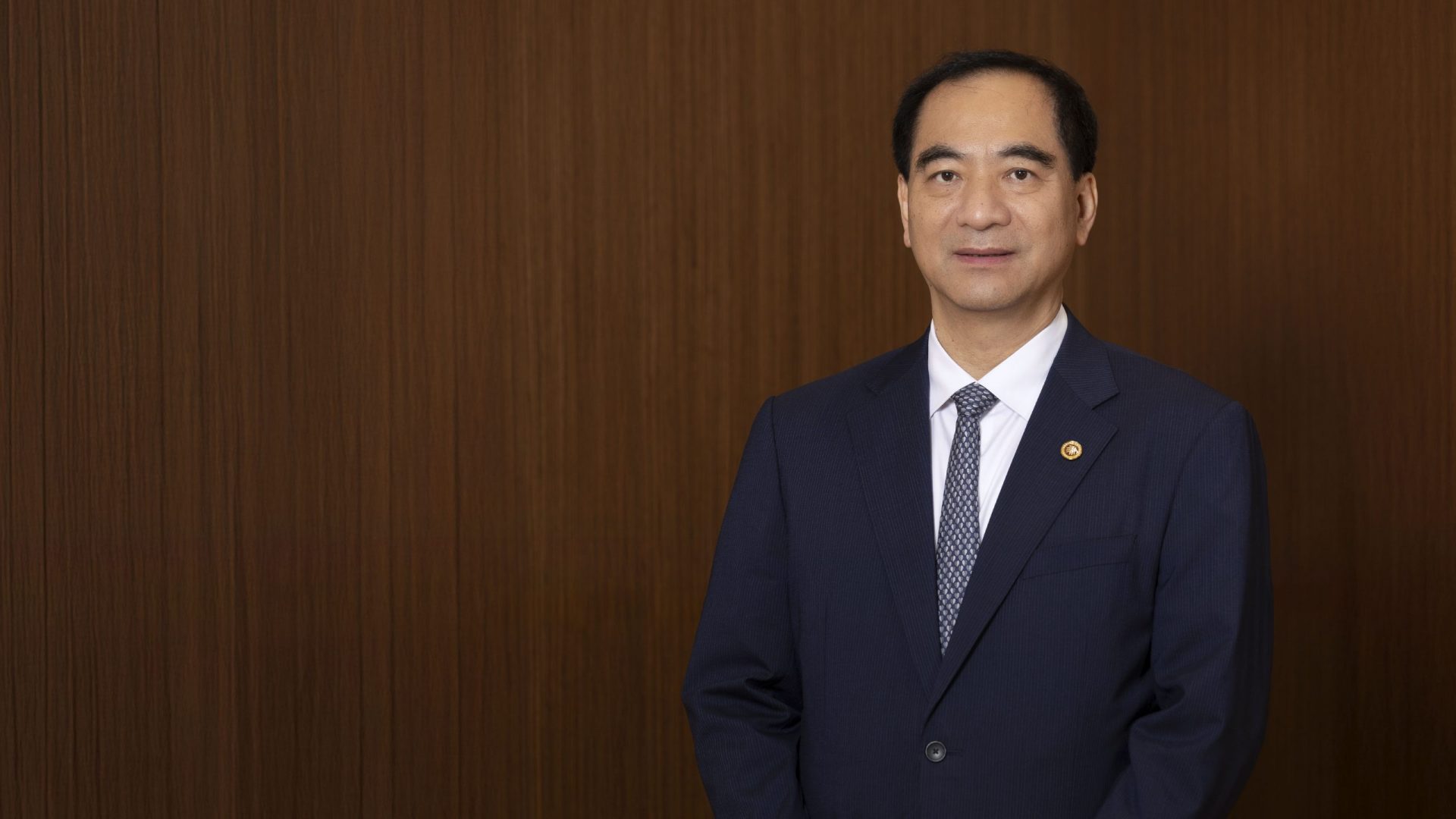
When the University of Macau (UM) conferred a Doctor of Science honoris causa on Gong Qihuang, president of Peking University (PKU), in 2025, the honour recognised far more than the scholarly achievements of a world‑leading optics scientist. It also acknowledged his distinctive vision of university leadership—one grounded in advancing scientific frontiers, serving national priorities, and strengthening academic collaboration between UM and PKU. Prof Gong’s journey, from entering PKU at the age of 15 to leading one of China’s foremost universities, reflects the trajectory of his scientific career: precise in focus, far‑reaching in impact, and transformative in influence. A pioneer of nonlinear optics and a steadfast advocate of educational cooperation between Beijing and Macao, he has left a lasting imprint on the development of science and higher education.
A lifelong research journey rooted in PKU
In 1979, at just 15 years old, Prof Gong entered the Department of Physics (now the School of Physics) at PKU after achieving the top science‑stream score in the National College Entrance Examination in Putian City, Fujian Province. His arrival coincided with a period often described as a springtime for science at PKU. Although material conditions were modest, intellectual ambition ran high, creating an atmosphere that left a lasting impression on the young student. Even today, Prof Gong recalls those years with clarity and energy. ‘I remember lining up at the library entrance at six in the morning just to find a seat,’ he says. ‘Everyone carried a belief in revitalising China.’ That shared conviction became a quiet but enduring force shaping his academic path.
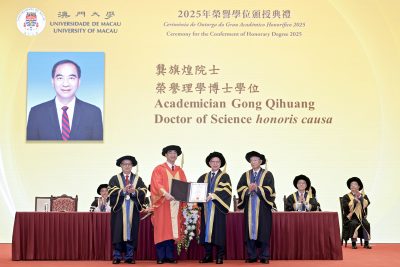
Prof Gong Qihuang receives a Doctor of Science honoris causa from UM
In an era without computers and with limited experimental resources, young scholars were driven not only by curiosity, but by confidence in the country’s future. While many of his peers chose to pursue further studies abroad after completing their undergraduate degrees, Prof Gong made a different choice, remaining at PKU for a combined master’s and doctoral programme. Later, during academic visits overseas in the 1980s and 1990s, he again declined opportunities to stay abroad under more favourable research conditions, choosing instead to return to China. What began as a personal decision gradually became a lifelong commitment—more than four decades devoted to PKU. A pivotal moment came in 1995, when Prof Gong received funding from the National Science Fund for Distinguished Young Scholars. ‘The grant amounted to 600,000 yuan, which was a substantial sum at the time,’ he recalls. He used the funding to purchase his first laser, marking the true beginning of his research career. ‘Without that support,’ he reflects, ‘I might not have achieved what I have today.’ Over time, this sense of gratitude evolved into a sustained commitment to supporting younger researchers, fostering a culture at PKU in which emerging talent is encouraged to grow from small sparks into guiding lights.
This virtuous cycle—linking individual dedication with national support—has enabled successive generations of researchers to thrive. Long devoted to nonlinear optics and small‑scale space-time optics, Prof Gong has emerged as a leading figure in the field, making systematic and innovative contributions spanning fundamental mechanisms, novel physical effects, and practical applications. His achievements have been recognised with numerous honours, including the Second Prize of the National Natural Science Award and the First Prize of the Ministry of Education Natural Science Award. His work has been selected three times among the ‘Ten Major Scientific and Technological Progress of China’s Colleges and Universities’ and twice as the ‘International Optics Progress of the Year’. Beyond individual achievements, Prof Gong’s influence has reshaped the institutional landscape of optics research at PKU. Under his leadership, the university’s optics discipline has grown into a research base of international standing. At the same time, the Frontiers Science Center for Nano‑optoelectronics of the Ministry of Education and the Yangtze Delta Institute of Optoelectronics at PKU—both established under his guidance—continue to advance the frontiers of global science and technology while responding to national strategic priorities.
Leadership in science and education
As an education administrator, Prof Gong draws on his personal experience to shape PKU’s approach to talent cultivation. Central to his educational philosophy is a careful balance between strategic direction and intellectual freedom. Reflecting on the evolution of China’s higher education system, he observes, ‘Earlier generations relied on diligence and conviction to overcome material scarcity. Today, following the implementation of national initiatives such as Project 211, Project 985, and the Double First‑Class programme, universities benefit from substantially improved research environments, many of them now comparable to world‑leading standards. However, our original mission of advancing science in service of the country has not changed.’
At PKU, this philosophy is translated into a two‑track model. On one track, the university preserves its tradition of inclusiveness by safeguarding faculty members’ freedom to pursue curiosity‑driven basic research. On the other, it advances major scientific and technological breakthroughs through organised, mission‑oriented research programmes. ‘We adopt a top‑level design to address some of the country’s most significant scientific and technological challenges,’ Prof Gong explains. ‘By forming teams and encouraging collaboration, we aim to strike a balance between free exploration and national priorities.’ In his view, this balance embodies the enduring spirit of PKU, in which patriotism, progress, democracy, and science are inseparable values. Interdisciplinary integration has thus become a defining feature of the university’s research strategy. For example, PKU has established cross‑disciplinary teams in emerging fields such as artificial intelligence and quantum information, respecting academic freedom while aligning with national strategic needs.
The same philosophy also guides Prof Gong’s approach to education and mentorship. He often recalls an episode from 1997, when he was supervising his first cohort of doctoral students. On the eve of Hong Kong’s return to China, the group was still struggling to obtain reliable results from a fluorescence upconversion experiment. After months of frustration, late that night they finally captured a critical signal. ‘The students were under intense pressure to graduate,’ he recalls, ‘but I encouraged them to persevere and trust that sustained effort would lead to a breakthrough.’ The experience became a lasting lesson in patience, resilience, and scientific faith. Today, this spirit of perseverance is embedded in PKU’s system for cultivating top‑level innovative talent. By immersing students in challenging research environments, the university seeks to develop not only technical competence, but also strategic vision and a resilient scientific mindset.
Shaping a new era of educational cooperation between Beijing and Macao
In Prof Gong’s view, the Doctor of Science honoris causa he received from UM is not only a personal honour, but also a testament to the enduring friendship between UM and PKU. Through his sustained efforts, the more than 20‑year partnership between the two institutions has evolved into a deeply collaborative strategic relationship. In 2023, Prof Gong and UM Rector Yonghua Song—long‑standing academic acquaintances—signed a new strategic cooperation framework agreement, committing both universities to the shared goal of developing into world‑class institutions with Chinese characteristics. Seeing UM as an important partner, Prof Gong emphasises the university’s distinctive position. Located in a city shaped by a rich blend of Chinese and Western cultures and situated within the Guangdong-Hong Kong-Macao Greater Bay Area, UM serves as a strategic bridge linking China and the wider world. This unique combination of cultural heritage and geographical advantage, he believes, gives the cooperation between UM and PKU particular significance.
The blueprint for collaboration between the two universities is now taking clearer shape. In addition to long‑standing cooperation in fields such as Basic Law studies and Portuguese and Spanish language and culture, new initiatives are being developed in faculty and student exchanges and the development of residential colleges. The two universities have also jointly launched the Digital Intelligence International Development Education Alliance to address the opportunities and challenges posed by the digital transformation of higher education. Looking ahead, they plan to leverage UM’s new campus in the Cooperation Zone in Hengqin to carry out joint research and contribute to the development of the Greater Bay Area. Reflecting on new models of international education, Prof Gong notes, ‘Peking University aims to become a world‑class university by around 2030. We hope to work with the University of Macau to attract and jointly cultivate more international students, thereby enhancing the internationalisation of education.’ In his view, this partnership represents not merely a sharing of resources, but a convergence of educational philosophies. By combining PKU’s strengths in fundamental disciplines with UM’s international outlook, the two universities are well positioned to develop a distinctive model of talent cultivation.
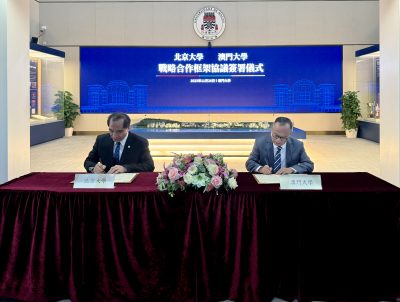
PKU President Gong Qihuang and UM Rector Yonghua Song sign a strategic cooperation agreement
Prof Gong also speaks highly of UM’s development trajectory. ‘From its beginnings as a community college to its emergence as a research university with multiple state key laboratories and major research platforms, UM’s achievements have benefited from the strong support of the central government and the Macao SAR government, as well as from its strategic integration into the national science and technology system,’ he says. He particularly commends UM’s ability to align closely with national needs while preserving its own unique characteristics, describing this as a development model worthy of broader reference.
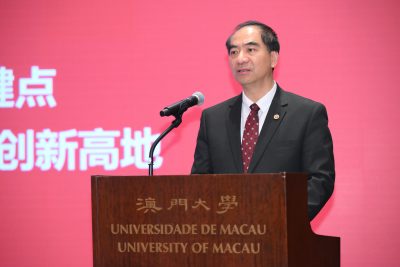
Prof Gong Qihuang delivers a lecture as part of UM’s University Lecture Series
Looking ahead, Prof Gong envisions further expanding cooperation with UM to promote collaborative research innovation and joint talent cultivation between Beijing and Macao, thereby helping to shape a new model of regional higher‑education cooperation in China. Previously, he delivered a lecture titled ‘Invigorating China through Science and Education, and Accelerating the Building of World Hubs for Talent and Innovation’ as part of UM’s University Lecture Series—a concise expression of this shared philosophy. When PKU’s profound academic heritage meets UM’s open and international vision, and when the rigorous scholarship of PKU’s Weiming Lake converges with Macao’s fusion of Chinese and Western wisdom, the partnership between the two universities is poised to become a vital hub for both talent and innovation.
Charting China’s path in the decade ahead
As global competition in science and technology intensifies, China’s capacity for breakthrough innovation in the decade ahead has become a central focus of international attention. Prof Gong argues that meeting this challenge begins with confidence—confidence rooted in sustained commitment to basic research. ‘Universities must not only tackle existing “bottleneck” problems,’ he says, ‘but also look beyond immediate demands and pursue original, forward‑looking research that defines the future rather than reacts to it.’
From entering PKU at the age of 15 to leading one of China’s foremost universities, Prof Gong’s career has unfolded in parallel with the country’s transformation in science and higher education since the reform and opening‑up era. His personal trajectory mirrors both the perseverance of an individual scientist and the evolution of China’s university system itself. It carries the legacy of two generations of scholars: one forged by a steadfast belief in national revitalisation, and another shaped by the modern imperative of scientific and technological self‑reliance. Grounded in national priorities yet informed by a global outlook, Prof Gong continues to embody the dual role of scientist and educator. With steady resolve, he presses forward to build a world‑class hub for talent and innovation—one defined not by short‑term gains, but by confidence, originality, and a long‑term vision for China’s place at the frontiers of science.
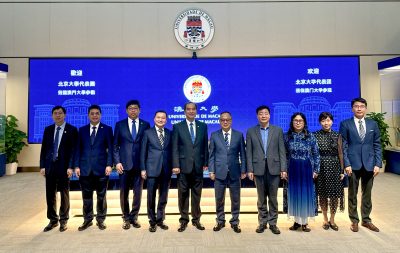
Prof Gong Qihuang leads a PKU delegation to visit UM
Profile of Prof Gong Qihuang
Prof Gong Qihuang is a world‑renowned expert in optics and a distinguished educator. He currently serves as president of Peking University and was among the first professors appointed under the Ministry of Education’s Changjiang Scholars Program. Prof Gong has long been engaged in frontier research in nonlinear optics and small-scale space-time optics. His work has produced systematic and innovative contributions to the understanding of material properties, the discovery of new optical phenomena, and their practical applications. In recognition of his academic achievements, Prof Gong was elected a fellow of the Institute of Physics (UK) in 2007, a fellow of Optica (formerly the Optical Society of America) in 2010, and a fellow of the International Society for Optics and Photonics (SPIE) in 2018. He was elected an academician of the Chinese Academy of Sciences in 2013 and a fellow of the World Academy of Sciences (TWAS) in 2018.
Chinese Text: Gigi Fan
English Translation: Bess Che
Photo: Editorial Team
Source: My UM Issue 151