In the saddle: Mentorship and growth through students’ eyes
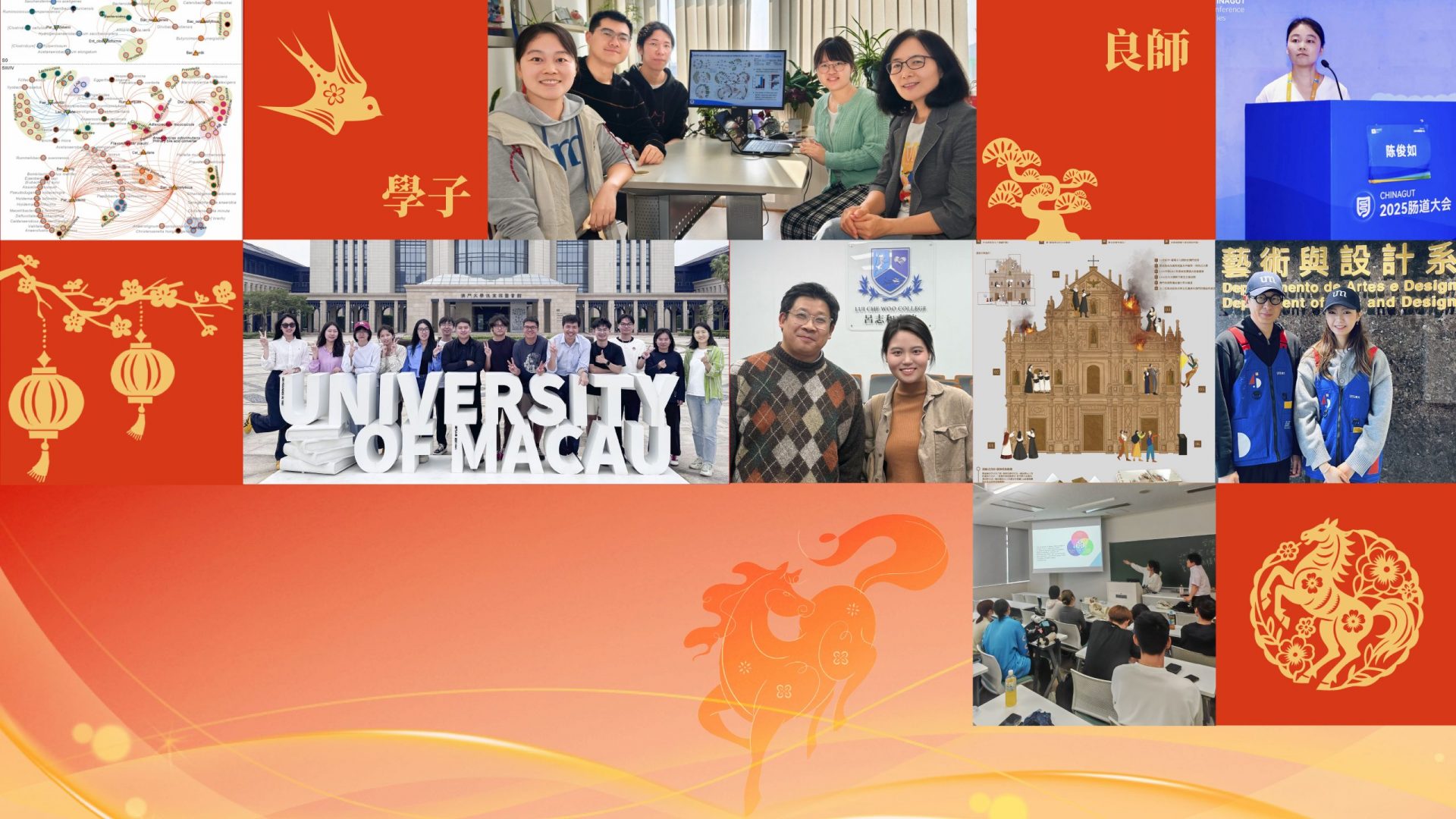
As we welcome the Year of the Horse, we wish everyone a steady and spirited journey forward. In learning, as in riding, progress is rarely measured by speed alone. Like a horse guided with care as it gathers strength, true growth depends on direction, endurance, and a steady rhythm. In this special season, students reflect on mentors who have recognised their potential, guided their pace with wisdom, and supported them at crucial moments—building their confidence and leaving lasting footprints not only in their academic pursuits, but also along their broader life journeys.
A talent scout who opens the world of mathematics
As the Chinese saying goes, ‘Only with a discerning eye can a talented horse be recognised.’ At Lui Che Woo College (LCWC), Yu Wanlu, a second‑year student, sees Prof Chao Kuok Fai, associate master of the college, as precisely such a mentor—one who recognises potential before it fully takes shape.
Yu first met Prof Chao during an LCWC training course for the International Mathematical Contest in Modelling in the US. Although she was majoring in Japanese studies, she had long nurtured a deep interest in mathematics. Lacking formal training, however, she approached the course with hesitation and self‑doubt. Yu still remembers her nervousness at the start of that first session, which quickly gave way to fascination as Prof Chao’s vivid and engaging teaching drew her in. Under his guidance, the symbols on the whiteboard seemed to come alive, reawakening a dormant curiosity.
That sense of recognition became clear when Yu finally gathered the courage to ask whether she could take part in the competition. Prof Chao’s immediate reply— ‘Of course!’—instantly dispelled her doubts. For Yu, the moment marked a turning point. More than a word of encouragement, it was an affirmation that reopened the door to a world she had once thought closed. Prof Chao does not define students by their academic backgrounds; instead, his inclusive outlook and decisive support reflect the discerning eye of a mentor who sees promise before it is fully revealed.
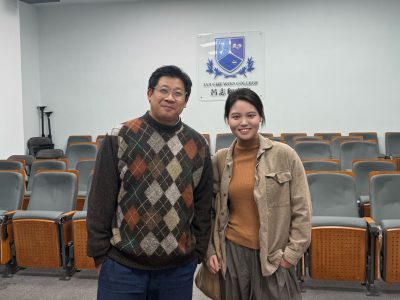
Yu Wanlu and Prof Chao Kuok Fai (left)
This approach is also evident in his classroom. Yu describes Prof Chao’s classes as a ‘learning paradise’ that draws students from across the university. Guided by the principle of teaching according to individual strengths, he welcomes learners from economics, computer science, resort management, and even Japanese studies. By approaching problems from multiple perspectives and drawing on examples from everyday college life, he makes abstract mathematical concepts both tangible and accessible.
Prof Chao’s mentorship extends well beyond teaching technique. Yu recalls that early in her academic journey, she struggled to produce work that met her own expectations, particularly when her limited experience left her feeling discouraged. Rather than being critical, Prof Chao responded with reassurance and trust, choosing to protect her initial enthusiasm. That encouragement became a powerful source of motivation. Prof Chao later supported her decision to transfer from Japanese studies to applied mathematics, guiding her patiently as she strengthened her foundations step by step.
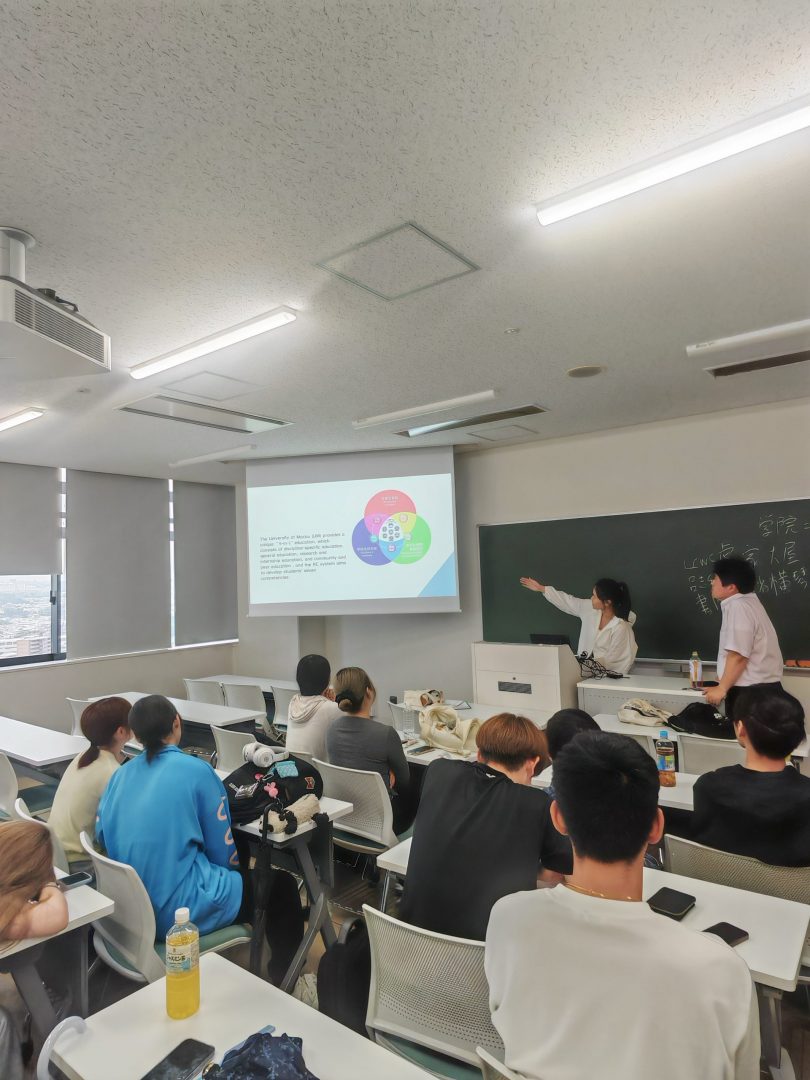
Yu Wanlu attends an exchange activity at Kyoto University on behalf of her college
Prof Chao’s actions suggest that recognising talent is only the first step, and that sustained trust and meaningful opportunities are essential for growth. In later training sessions, he often shared Yu’s experience to encourage students from other disciplines to challenge themselves and embrace interdisciplinary learning. He also recommended Yu as a teaching assistant for the Big Data Tutorial Programme, entrusting her with the responsibility of supporting others—a gesture that reflected both confidence and respect.
In Yu’s eyes, Prof Chao is more than a teacher. He is a steady presence in the college community—someone who listens thoughtfully whether the conversation turns to academics, career choices, or personal aspirations. Through this quiet companionship, his role extends beyond mentorship, serving as a trusted guide who supports students as they find their own paths forward.
Steering research with care and expertise
Scientific research is often likened to a long and demanding academic race—one that tests not only endurance, but also vision, judgement, and leadership. Chen Junru, a doctoral student at the Institute of Chinese Medical Sciences (ICMS) at UM, knows this challenge well. Recently, she published a study on colorectal cancer in Nature Communications, marking a significant milestone in her academic journey. The study was the first to systematically reveal the dynamic landscape of gut microbial β‑glucuronidases (GUSs) during the development of colorectal cancer. As the paper’s first author, Chen attributes this achievement largely to the guidance she received from her mentor, Prof Yan Ru of ICMS. In Chen’s eyes, Prof Yan embodies the spirit of a skilled jockey—using rigour as her reins, having the foresight necessary to chart the course ahead, and serving as a personal example to sustain the team’s persistence and drive.
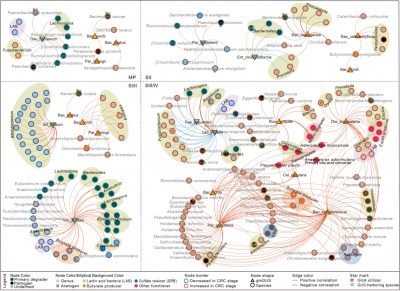
Research conducted by Chen Junru and her team reveals the dynamic landscape of gut microbial β-glucuronidases (GUSs) during the development of colorectal cancer
This ‘jockey spirit’ is most evident in Prof Yan’s uncompromising approach to research quality. She conceives of the pursuit of excellence not as an occasional goal, but as a habit embedded in every stage of the research process. When Chen was preparing the first draft of her paper, Prof Yan’s supervision went far beyond surface‑level revisions. She required Chen to return to the original literature, extract and synthesise key information with precision, and refine the manuscript through multiple rounds of revision. Through this process, she helped Chen develop a clear and logically coherent narrative grounded in scientific insight. As Chen recalls, Prof Yan consistently emphasised that data should never stand alone; it must be integrated into a structured framework of scientific questions and hypotheses to form a persuasive and biologically meaningful argument.
A capable jockey must also possess strategic vision and the ability to navigate obstacles. When faced with large volumes of complex data, Prof Yan encouraged Chen to reorganise the information according to functional relevance, transforming apparent disorder into a clear and interpretable structure. When cross‑cohort analyses revealed significant microbial heterogeneity, she guided Chen to view this complexity not as a limitation but as an opportunity—one that could open new avenues for more precise patient classification and treatment. In this way, challenges became opportunities for innovation. To help advance the research, Prof Yan also ensured that the team remained connected to developments at the forefront of the field. She encouraged students to incorporate emerging paradigms in microbiology and metabolism into the analysis of their self‑built cohorts and to pursue innovation grounded in a thorough understanding of current scholarship. In her view, scientific excellence is achieved not through isolated breakthroughs, but through sustained, in‑depth inquiry and continual refinement.
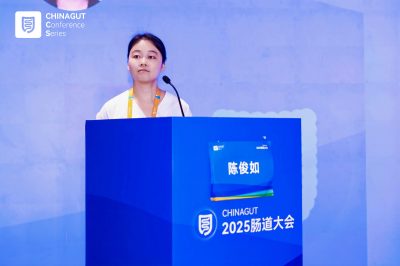
Chen Junru presents the research findings at the 2025 China Gut Conference
Beyond individual projects, Prof Yan places particular emphasis on cultivating students’ long‑term vision and academic endurance. Through systematic training and sustained support, she helps young researchers maintain direction in a field that demands patience and resilience.
First‑year students in her team are required to submit in‑depth literature review reports every week, gradually strengthening their analytical thinking and their ability to identify emerging trends. This process helps them integrate into the field while steadily clarifying and refining their own research directions. Prof Yan also encourages students to attend academic conferences, follow cutting‑edge developments, and ‘go out and see the world’. Exposure to broader scholarly communities, she believes, sparks new ideas and fosters intellectual growth. She actively recommends outstanding students to present at major conferences, supporting their academic visibility and long‑term career development.
Under Prof Yan’s guidance, Chen and the team successfully uncovered the dynamic landscape of GUSs and constructed a functional framework for the microbiota–GUS–metabolite axis in colorectal cancer progression, laying a foundation for future research into early diagnostic biomarkers and novel therapeutic targets. For Chen, Prof Yan is not only a researcher advancing on her own track, but also a mentor who carefully cultivates the next generation of scholars—passing on the spirit of rigour, vision, and endurance.
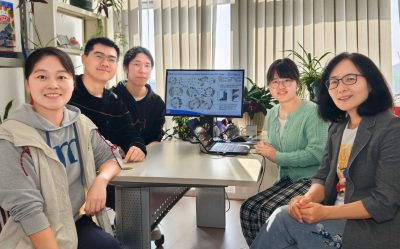
(From left) Chen Junru, Tang Shuai, Jin Wenyu, Li Yan, and Prof Yan Ru
Nurturing students’ imagination
Even the most brilliant ideas can fade quickly without guidance to shape their direction. For master’s student Lai Chi Ngao, Prof Wang Xiaofeng, associate professor in the Department of Arts and Design, is precisely the mentor who helps channel boundless creativity into meaningful design. Lai especially admires Prof Wang’s ‘WHY Method’’—an approach that allows imagination to roam freely while providing a clear framework for reflection and execution. In the course ‘Contemporary Design and Critique’, this method became a bridge that enabled Lai to engage in dialogue with history and transform abstract ideas into tangible outcomes.
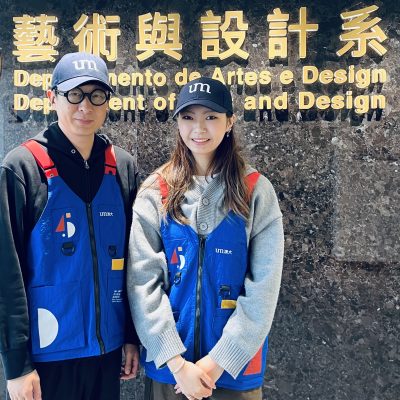
Lai Chi Ngao (right) and Prof Wang Xiaofeng
At the outset, Lai began with a single intuitive impulse: to bring the history of the Ruins of St. Paul’s to life. Rather than making an immediate judgement, Prof Wang responded with a series of probing questions: Why does history need to come alive? Is the goal to bridge the distance between tourists and silent stone relics, or to rebuild empathy with the past? Through this process, Lai uncovered the core motivation behind her concept, anchoring her emotional impulse in a clear creative purpose—bridging cultural and historical gaps.
With that purpose established, Prof Wang encouraged her to consider form. What should the work become—a picture book, a poster, or an interactive game? Gradually, Lai’s initially vague vision took shape as a set of assemblable, interactive picture‑book covers. Attention then turned to execution: how the idea would be realised, what visual language it would adopt, and how time would be represented. Drawing inspiration from architectural sectional drawings, Lai compressed the historical timeline vertically into the façade of the stone arch of the Ruins of St. Paul’s. By layering transparent film over the book covers, she created an interactive mechanism that allows history to be seen, assembled, and explored.
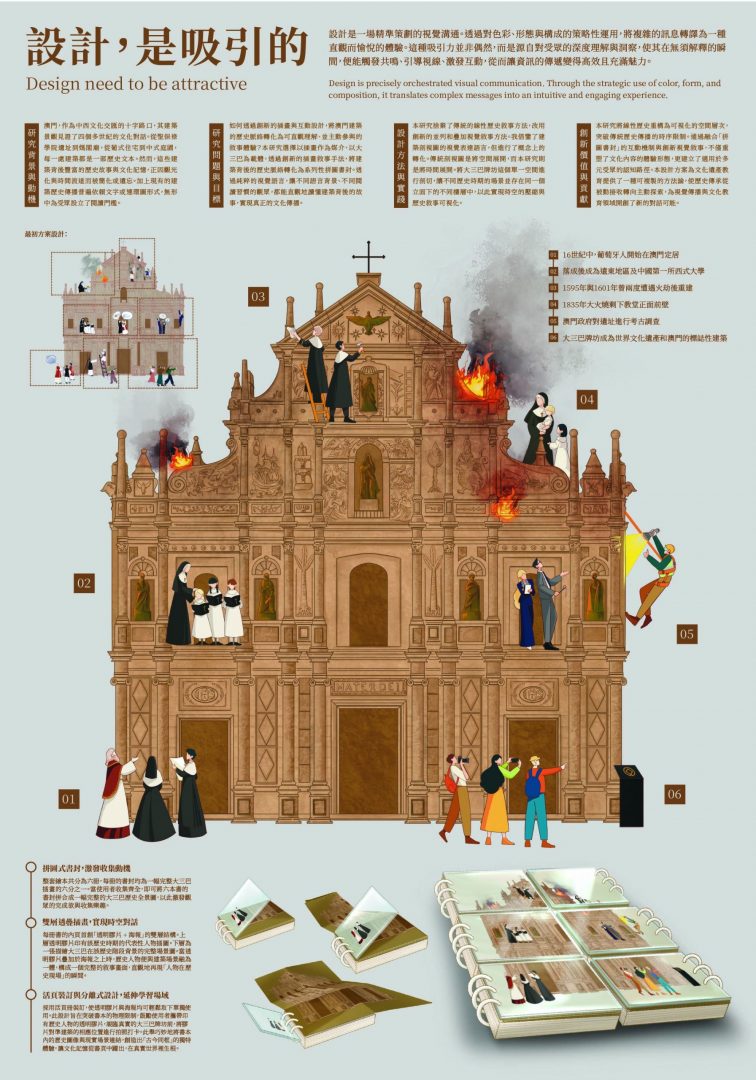
Design work by Lai Chi Ngao
Strong creative work, however, also demands rigorous refinement. Prof Wang turns the classroom into a space for critical thinking, where peer critique plays an essential role. During the review of Lai’s project, classmates posed questions such as: Can the image be understood at first glance? Does the sense of play balance the seriousness of history? These challenges tested the resilience of her ideas. Through repeated revision and defence, the project evolved from a rough concept into a refined and coherent design. Under Prof Wang’s guidance, Lai’s imagination no longer drifted freely, but followed a clear trajectory—from motivation, to form, to execution—culminating in a tangible and engaging historical picture book.
Beyond individual projects, Lai also finds inspiration in Prof Wang’s professional practice. In her eyes, his design of UM’s 45th anniversary logo offers a powerful lesson in how imagination and discipline converge. ‘A logo is not mere decoration,’ she observes. ‘It condenses complex meaning into a single image. Centred on the number 45, the logo reflects the traditional Chinese philosophical concept of “heaven is round and earth is square”, while also resembling a sailing flag, echoing the anniversary theme “Strive Forward and Achieve Beyond”. Subtly, it also incorporates the outline of a human face, highlighting UM’s people‑centred educational philosophy.’ To Lai, this design demonstrates that effective design must be thoughtful and ingenious.
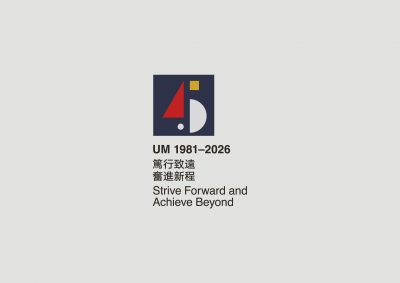
The UM 45th anniversary logo, designed by Prof Wang
Guiding the long run in academia
Building an academic career is often compared to running a marathon. It is not a test of short‑term speed, but one of endurance, balance, and long‑term perspective. Along this journey, Liu Yitong, a doctoral student in political science, and Chen Zhixian, a fourth‑year student in international relations, have found in Prof Lam Ka Ian, assistant professor in the Department of Government and Public Administration, not only a thoughtful guide, but also a mentor who demonstrates how to move steadily and meaningfully over the long distance.
For Liu, who had just begun her doctoral studies, the greatest challenge was anxiety over finding a ‘perfect’ research topic. Prof Lam’s advice was straightforward and practical: ‘Instead of overthinking, start by taking action.’ She encouraged Liu to step beyond her disciplinary comfort zone and examine international environmental politics from an external perspective. This guidance helped Liu build resilience and adaptability, much like cross‑training strengthens a long‑distance runner. Acting on this advice, Liu explored interdisciplinary approaches, integrating critical perspectives into her research and gradually breaking away from conventional frameworks.
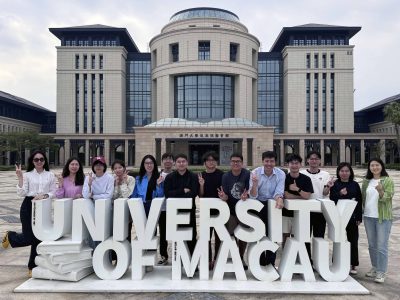
Prof Lam Ka Ian (second from right) with her students
Prof Lam also recognises that no academic journey can be sustained without attention to mental and physical well‑being. In addition to discussing research progress, she regularly checks in on her students’ daily lives, emphasising that a lasting academic career must rest on a healthy foundation. Inspired by this idea, Liu took up running and soon found that the steady rhythm of her steps helped her organise her thoughts. What began as exercise gradually became a form of ‘mobile meditation’, offering both stress relief and mental clarity. Through this experience, Liu came to realise that an academic marathon engages the whole person, not just the mind.
In the classroom, Prof Lam similarly encourages students to look beyond the boundaries of academia. For Chen, Prof Lam is a mentor who brings abstract theories back into the texture of real life. For example, in her ‘International Relations History’ course, Prof Lam shared her experience speaking with residents and scholars during her time in Africa. These grounded stories helped Chen recognise that the vitality of political science lies in the resilience of ordinary people, and that meaningful research begins with sincere observations of the real world.
Chen has also noticed that Prof Lam’s office is filled with handicrafts and small decorations collected during fieldwork. These quiet details wordlessly convey an academic philosophy: rigorous scholarship grows out of genuine curiosity about life and deep engagement with the world beyond the classroom.
Beyond research guidance, Prof Lam encourages students to think carefully about their long‑term paths. She often reminds Chen, ‘The track is wide—don’t force yourself into a single direction.’ Her advice is to engage in early preparation of multiple options, whether in public service, further study, or international organisations. This calm confidence reflects her own varied experience. After graduating from UM, Prof Lam pursued a second degree in Portugal, worked as a government translator drawing on her formidable Portuguese language skills, and later conducted extensive fieldwork across Africa. Through her own journey, Prof Lam demonstrates that the goal of the academic marathon is not reaching a single destination, but sustaining purpose, curiosity, and growth over the long run.
Journeying forward through the Year of the Horse
The journey of learning is like a horse travelling a long distance—it is not defined by a momentary sprint, but by steady progress shaped through reflection and daily growth. A mentor’s role is not to urge students forward at every step, but to recognise potential, guide direction, protect curiosity, and walk alongside them at critical moments. Through trust, patience, and timely guidance, mentors help students find their own rhythm and advance with confidence. As we enter the Year of the Horse, may every student, under the guidance of dedicated teachers, continue their journey with calm determination—moving steadily along their own path and carrying their aspirations forward into a world of new possibilities.
Chinese Text: U Wai Ip, Senior UM Reporter Qi Zizheng
Chinese Editor: Gigi Fan
English Translation: Bess Che
Photo: Editorial Team, with some provided by the interviewee
Source: My UM Issue 151